Want to be in the loop?
subscribe to
our notification
Business News
LARGE BANKS STEP UP FOREIGN CAPITAL ATTRACTION
Experts forecast that this year, banks will race to increase their charter capital in order to improve capital adequacy ratios and meet the capital needs for high credit growth.
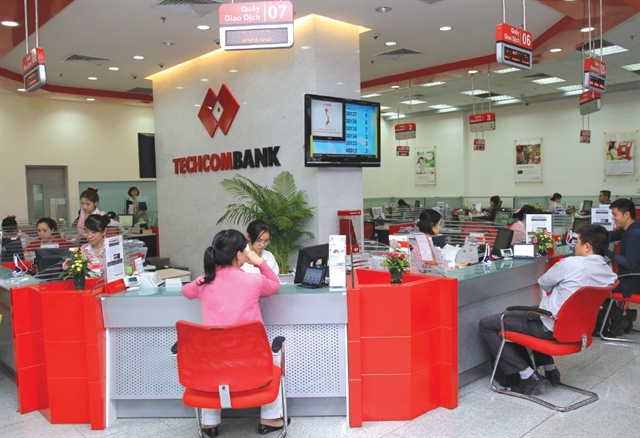
Techcombank is expected to sell 10-15 per cent of its shares to long-term strategic investors, with priority given to partners with technological capabilities. — Photo cafef.vn
HÀ NỘI — Large banks such as Techcombank, Vietcombank and BIDV are set to promote their capital sale plans to attract foreign strategic investors this year.
Techcombank is expected to sell 10-15 per cent of its shares to long-term strategic investors, with priority given to partners with technological capabilities. Currently, the foreign ownership ratio at Techcombank is 22 per cent.
At Vietcombank, Nguyễn Thanh Tùng, chairman of the bank’s board of directors, confirmed at the bank’s shareholder meeting last year that a plan to issue individual shares to increase capital is still underway in order to realise the bank’s strategic goals, as well as meet increasingly strict international standards.
Specifically, Vietcombank’s selection of financial consultants was completed in January 2024. After that, the bank organised many events to meet investors in Singapore, the UK and Hong Kong (China).
Tùng said Vietcombank is still working closely with international consultants to realise this plan. The bank expects to be able to complete the private issuance plan in the first half of 2025 if the market develops favourably.
For BIDV, after the State Bank of Vietnam approved an increase in charter capital according to the private share issuance plan, the bank will offer 123.8 million private shares to professional investors in the first quarter of 2025 at VNĐ38,800 per share. With more than VNĐ4.8 trillion expected to be earned from this issuance, the bank's charter capital is forecast to exceed VNĐ70.2 trillion.
Four foreign investors and one domestic investor are expected to buy up BIDV’s shares. Of these, Vietnam Enterprise Investments Limited (VEIL) has registered to buy nearly 59 million shares, accounting for 47.7 per cent of the total offering. Other investors, including Hanoi Investments Holdings Limited, DC Developing Markets Strategies Public Limited Company and Samsung Vietnam Securities Master Investment Trust (SSMIT), registered to buy 15.7 million shares, 8.5 million shares and more than 1.9 million shares, respectively.
The domestic investor State Capital Investment Corporation (SCIC) has registered to buy 38.7 million shares of BIDV.
In addition to the above deal, a plan to privately issue 9 per cent of BIDV’s shares to strategic investors is also expected to be completed this year.
At a recent investor conference, BIDV leaders said that the bank is working with potential investors to carry out its first private issuance with a rate of 2.9 per cent in the first quarter of 2025. The remaining 6.1 per cent will be implemented later, depending on market conditions.
Experts forecast that this year, banks will race to increase their charter capital in order to improve capital adequacy ratios and meet the capital needs for high credit growth, as the Government has set an economic growth target of at least 8 per cent.
Trần Kiều Oanh of financial service provider FiinGroup’s Market Research and Consulting Services Division said the capital increase race will likely help banks ensure sustainable operations amid increasing bad debt ratios and decreasing bad debt coverage ratios in the entire banking system.
Oanh added that increasing capital will also create a foundation for business expansion in strategic areas. — VNS
Source: VNS
Related News

VIETNAM ECONOMY INVESTMENT
FOREIGN INVESTORS SEEKING A SYNCHRONISED MANUFACTURING ECOSYSTEM
Instead of focusing only on land costs and incentives as usual, foreign investors are seeking a synchronised manufacturing ecosystem, from stable power supply and logistics to shared infrastructure and the convenience of completing residence procedures for experts to serve their long-term investment in the country.

INFRASTRUCTURE / CONSTRUCTION / LOGISTIC / PORT
DONG THAP PROVINCE STEPS UP INDUSTRIAL EXPANSION AND INFRASTRUCTURE CONNECTIVITY
Accelerating public investment, strengthening inter-regional connectivity, and expanding industrial land are helping Dong Thap efficiently bolster competitiveness and drive economic growth. Following the 2025 merger of the former Dong Thap and Tien Giang provinces, the expanded Dong Thap province in the Mekong Delta faces mounting pressure to accelerate infrastructure development and strengthen connectivity among local economic zones, urban areas, industrial parks (IPs), and production centres.

PROPERTY / INDUSTRIAL ZONE
HCM CITY ATTRACTS US$5.7 BILLION INTO EXPORT PROCESSING AND INDUSTRIAL ZONES
HCM City attracted US$5.7 billion in domestic and foreign investment into its export processing and industrial zones during the first nine months of 2026. The figure exceeded the city's full-year target by 31 per cent, highlighting strong momentum in high-quality industrial investment under Resolution No.10-NQ/TW. Total investment reached 131 per cent of the 2026 target of $4.25 billion and represented a 29 per cent increase compared with the same period in 2025, according to the city's Export Processing and Industrial Zones Authority (HEPZA).

BANKING / FINANCE / INSURANCE / TAX
REMITTANCES TO HCM CITY RISE NEARLY 40% IN Q3
Remittances to HCM City reached more than US$2.83 billion in the third quarter of this year, up 39.5 per cent from the previous quarter and 3.6 per cent year-on-year. This was the first quarter showing positive annual growth this year, helping narrow the decline in remittance inflows over the first nine months. According to the State Bank of Vietnam (SBV)’s Regional Branch 2, remittances transferred to HCM City through credit institutions and economic organisations totalled $2.835 billion in Q3, an increase of more than $802 million from the previous quarter.

VIETNAM ECONOMY INVESTMENT
LOCALITIES REPORT BREAKTHROUGH RESULTS IN FDI IN FIRST NINE MONTHS
In Ho Chi Minh City, total registered capital reached $17.2 billion in the first nine months, up 4.2 times from the same period last year. The figure included more than $9.35 billion in newly registered capital and over $4.9 billion in additional capital for existing projects. Foreign investors also registered more than $2.9 billion through capital contributions and share purchases.

TECHNOLOGY
TECH SECTOR GROWTH OPENS UP OPPORTUNITIES FOR VIỆT NAM TO GO GLOBAL
The growth of the electronics, semiconductor and high-tech sectors worldwide is opening up a variety of opportunities for Vietnamese enterprises to integrate more deeply into the global supply chain. However, to become suppliers for these corporations, domestic enterprises must meet rigorous standards regarding quality, technology, productivity and order fulfilment capabilities.
Events Sponsors






















