Want to be in the loop?
subscribe to
our notification
Business News
LÂM ĐỒNG TARGETS DIGITAL ECONOMY TO ACCOUNT FOR 30 PER CENT OF GRDP BY 2030
The province will support SMEs in assessing their level of digital transformation, developing digitalisation roadmaps and applying technology to management, finance, human resources, customer relations and supply chains.
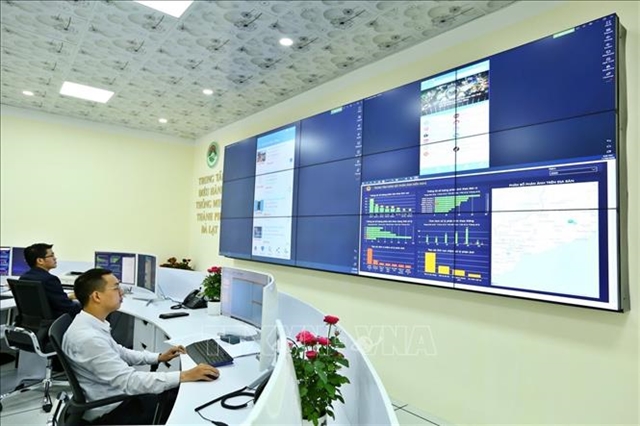
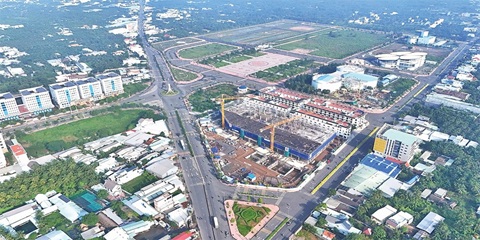
Intelligent Operation Center in Lâm Đồng Province. The province has issued a plan to develop digital economy and society by 2030. — VNA/VNS Photo Minh Quyết
LÂM ĐỒNG — Lâm Đồng Province aims to raise the digital economy’s contribution to around 30 per cent of its gross regional domestic product (GRDP) by 2030, as part of a five-year plan to develop digital economy and society issued recently.
Under Plan No. 15358/KH-UBND, the province targets more than 60 per cent of small- and medium-sized enterprises (SMEs) to adopt digital technologies by 2030 while increasing the value of cashless payments to 30 times its GRDP.
The plan also set the goal of raising the share of university enrolment in science, technology, engineering and mathematics (STEM) to 40 per cent.
These are considered important indicators to boost labour productivity and competitiveness as well as creating new sources of growth driven by science, technology and digital transformation.
To develop a digital society, the province plans to ensure all households have access to fibre-optic broadband with a minimum speed of 1 Gbps.
In addition, 5G networks at speeds of at least 100 Mb per second is planned to cover 99 per cent of the population.
All citizens aged 14 and above are expected to have identity cards and electronic identification accounts, while more than 95 per cent of people aged 15 and above are targeted to have transaction accounts at banks or authorised financial institutions.
The province aims for more than 70 per cent of people aged 18 and above to have personal digital or electronic signatures. At least 50,000 people of working age will get training of basic digital skills while more than 95 per cent of residents are expected to have electronic health records.
Under the plan, Lâm Đồng has also set specifc targets for each sector.
In agriculture, the province aims for 70 per cent of communes to have cooperatives using digital technology solutions or platforms. At least 70 per cent of high-tech agricultural products are expected to meet quality standards, carry recognised brands and have QR-code for traceability.
All of its One Commune One Product (OCOP) products will be digitalised. The province will also support at least 1,900 businesses and other entities to put more than 4,000 agricultural and OCOP products on domestic and international e-commerce platforms.
In tourism, at least 70 per cent of establishments are expected to use digital platforms for management and operation, while all community tourism sites are targeted to apply information technology and digital transformation.
Of note, tourist attractions, historical sites and scenic destinations will be digitised using 3D and VR360 technologies, alongside the development of databases and digital maps for community tourism.
To achieve the targets, the province has identified digital infrastructure, data infrastructure and shared digital platforms as priorities.
The focus would be on expanding fibre-optic networks, increasing 5G coverage and modernising connectivity between information systems.
A shared geospatial database will be completed and connected with with data systems in land, forestry, agriculture, construction and transport.
Lâm Đồng plans to issue a strategy for applying artificial intelligence (AI) in state agencies in 2027. During 2027-28, AI will be piloted to support administration, data analysis and forecasting.
Between 2027 and 2029, the province plans to deploy virtual assistants and AI chatbots to help residents and businesses with administrative procedures and online public services. AI applications will also be promoted in agriculture, healthcare, education, tourism, resources and environment, industry and trade.
Alongside technological development, the province will strengthen information security, cybersecurity and data protection.
The province will support SMEs in assessing their level of digital transformation, developing digitalisation roadmaps and applying technology to management, finance, human resources, customer relations and supply chains.
It will also promote e-commerce, digital payments, electronic invoices, electronic contracts and digital signatures. — VNS
Source: VNS
Related News

BANKING / FINANCE / INSURANCE / TAX
REMITTANCES TO HCM CITY RISE NEARLY 40% IN Q3
Remittances to HCM City reached more than US$2.83 billion in the third quarter of this year, up 39.5 per cent from the previous quarter and 3.6 per cent year-on-year. This was the first quarter showing positive annual growth this year, helping narrow the decline in remittance inflows over the first nine months. According to the State Bank of Vietnam (SBV)’s Regional Branch 2, remittances transferred to HCM City through credit institutions and economic organisations totalled $2.835 billion in Q3, an increase of more than $802 million from the previous quarter.
TECHNOLOGY
TECH SECTOR GROWTH OPENS UP OPPORTUNITIES FOR VIỆT NAM TO GO GLOBAL
The growth of the electronics, semiconductor and high-tech sectors worldwide is opening up a variety of opportunities for Vietnamese enterprises to integrate more deeply into the global supply chain. However, to become suppliers for these corporations, domestic enterprises must meet rigorous standards regarding quality, technology, productivity and order fulfilment capabilities.
VIETNAM ECONOMY INVESTMENT
FOREIGN INVESTORS SEEKING A SYNCHRONISED MANUFACTURING ECOSYSTEM
Instead of focusing only on land costs and incentives as usual, foreign investors are seeking a synchronised manufacturing ecosystem, from stable power supply and logistics to shared infrastructure and the convenience of completing residence procedures for experts to serve their long-term investment in the country.

MEMBER CORNER / PROMOTIONS
SENTRYSAFE FHW40200 – PROTECT YOUR VALUABLES, ENJOY PEACE OF MIND!
Looking for a reliable solution to protect your important documents, cash, and valuables from fire and water damage? Genuine SENTRYSAFE - Reliable protection for your valuables and peace of mind! Contact Sen Wai Vietnam for more information and personalized product recommendations.
PROPERTY / INDUSTRIAL ZONE
HCM CITY ATTRACTS US$5.7 BILLION INTO EXPORT PROCESSING AND INDUSTRIAL ZONES
HCM City attracted US$5.7 billion in domestic and foreign investment into its export processing and industrial zones during the first nine months of 2026. The figure exceeded the city's full-year target by 31 per cent, highlighting strong momentum in high-quality industrial investment under Resolution No.10-NQ/TW. Total investment reached 131 per cent of the 2026 target of $4.25 billion and represented a 29 per cent increase compared with the same period in 2025, according to the city's Export Processing and Industrial Zones Authority (HEPZA).
INFRASTRUCTURE / CONSTRUCTION / LOGISTIC / PORT
DONG THAP PROVINCE STEPS UP INDUSTRIAL EXPANSION AND INFRASTRUCTURE CONNECTIVITY
Accelerating public investment, strengthening inter-regional connectivity, and expanding industrial land are helping Dong Thap efficiently bolster competitiveness and drive economic growth. Following the 2025 merger of the former Dong Thap and Tien Giang provinces, the expanded Dong Thap province in the Mekong Delta faces mounting pressure to accelerate infrastructure development and strengthen connectivity among local economic zones, urban areas, industrial parks (IPs), and production centres.
Events Sponsors






















