Want to be in the loop?
subscribe to
our notification
Business News
INVESTORS EXPLORE THE UNTAPPED POTENTIAL OF VIETNAM’S NORTH CENTRAL REGION IN EXCLUSIVE WEBINAR
Vietnam, 3 October 2024 – A highly informative webinar, titled "Unlocking Opportunities in the North Central Region of Vietnam for Investment," took place this morning from 8:00 AM to 10:00 AM. Co-hosted by WHA Vietnam, BIDV Vietnam, and Deloitte Vietnam, the event attracted a diverse audience of investors and business leaders from Japan and other countries, who came together to explore the investment potential of the North Central Region, with a particular focus on Nghe An Province.
The webinar provided valuable insights into the region's economic landscape, infrastructure development, and strategic opportunities, positioning it as a rising hub for investment in Vietnam. Presentations from experts at BIDV Securities, Deloitte Vietnam, and WHA highlighted the region’s growing significance in Vietnam's economic transformation.
Key Highlights:
Economic Overview by BIDV Securities
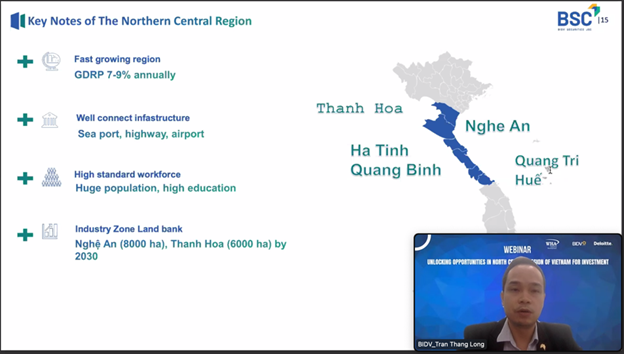
Mr. Tran Thang Long, Head of Research at BIDV Securities, delivered a comprehensive analysis of Vietnam’s macroeconomic landscape, with a particular focus on the North Central Region. He highlighted Vietnam’s accommodative monetary policies and fiscal measures, which have contributed to a stable economic environment in 2024. He also underscored the country’s strong foreign direct investment (FDI) growth, a 6.93% GDP expansion in Q2 2024, and robust trade performance, all of which reinforce Vietnam’s competitiveness as a destination for global investors.
The North Central Region, including key provinces such as Nghe An and Thanh Hoa, was noted for its steady GDP growth, advanced infrastructure, and extensive availability of large industrial land banks. Mr. Tran Thang Long emphasized that the region’s well-connected transportation systems, including expressways, seaports, and airports, position it to support further industrial development and attract increased foreign investment.
Global Minimum Tax (GMT) and Its Impact on Investors
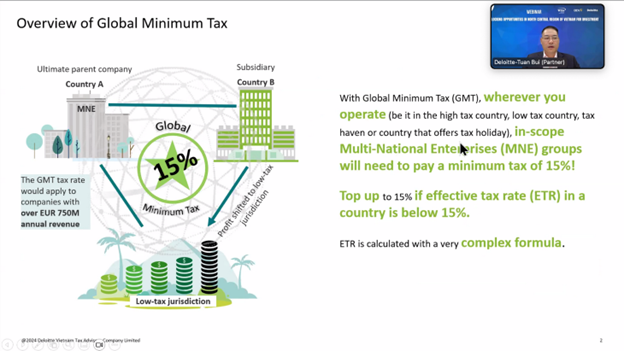
Mr. Bui Ngoc Tuan, Partner at Deloitte Vietnam, provided a comprehensive update on the Global Minimum Tax (GMT) framework, which is poised to reshape the global tax landscape. He outlined the key implications for multinational enterprises (MNEs) operating in Vietnam, where GMT regulations will take effect in January 2024. His presentation focused on how Vietnam’s Qualified Domestic Minimum Top-up Tax (QDMTT) and other GMT mechanisms will impact MNEs, particularly those currently benefiting from preferential tax rates.
Mr. Tuan emphasized that while the GMT introduces new compliance challenges, the Vietnamese government has been proactive in preparing businesses for the transition. These efforts are aimed at ensuring that Vietnam remains an attractive destination for foreign investment, particularly in high-tech and strategically important sectors.
WHA Vietnam’s Vision for Smart-Eco Industrial Parks
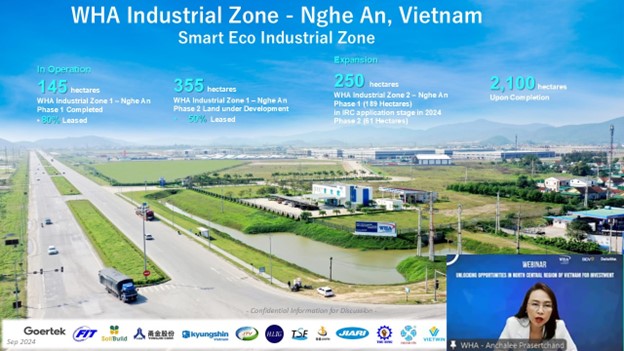
Ms. Anchalee Prasertchand, Vice President of WHA Vietnam, highlighted WHA’s leadership in developing eco-friendly industrial zones, with a particular focus on WHA Industrial Zone 1 – Nghe An.
WHA Group is proud to spearhead the development of WHA Industrial Zone 1 – Nghe An, a Smart Eco-Industrial Zone that strategically unlocks investment opportunities in North Central Vietnam. With its superior infrastructure, lower land and labor costs, and access to a skilled workforce, Nghe An offers unparalleled advantages for global manufacturers. Positioned as a key manufacturing hub with strong government support, this region provides investors with a sustainable, cost-effective, and highly efficient environment. Our long-term vision, focused on sustainable growth and innovation, ensures that WHA Industrial Zone 1 will continue to be a prime destination for businesses seeking to thrive in Vietnam’s growing industrial landscape.
The webinar served as a critical platform for businesses and investors to explore the expanding opportunities in Vietnam’s North Central Region. It underscored the region's potential to become Vietnam’s next manufacturing hub, driven by strategic infrastructure enhancements, government incentives, and a skilled, abundant workforce.
By addressing vital topics such as Vietnam’s economic outlook, the impact of global tax reforms, and WHA’s sustainable development initiatives, the webinar equipped participants with actionable insights to make informed investment decisions. It also fostered international collaboration, particularly with Japanese investors, showcasing Vietnam's commitment to creating a favorable investment environment.
Interactive Session
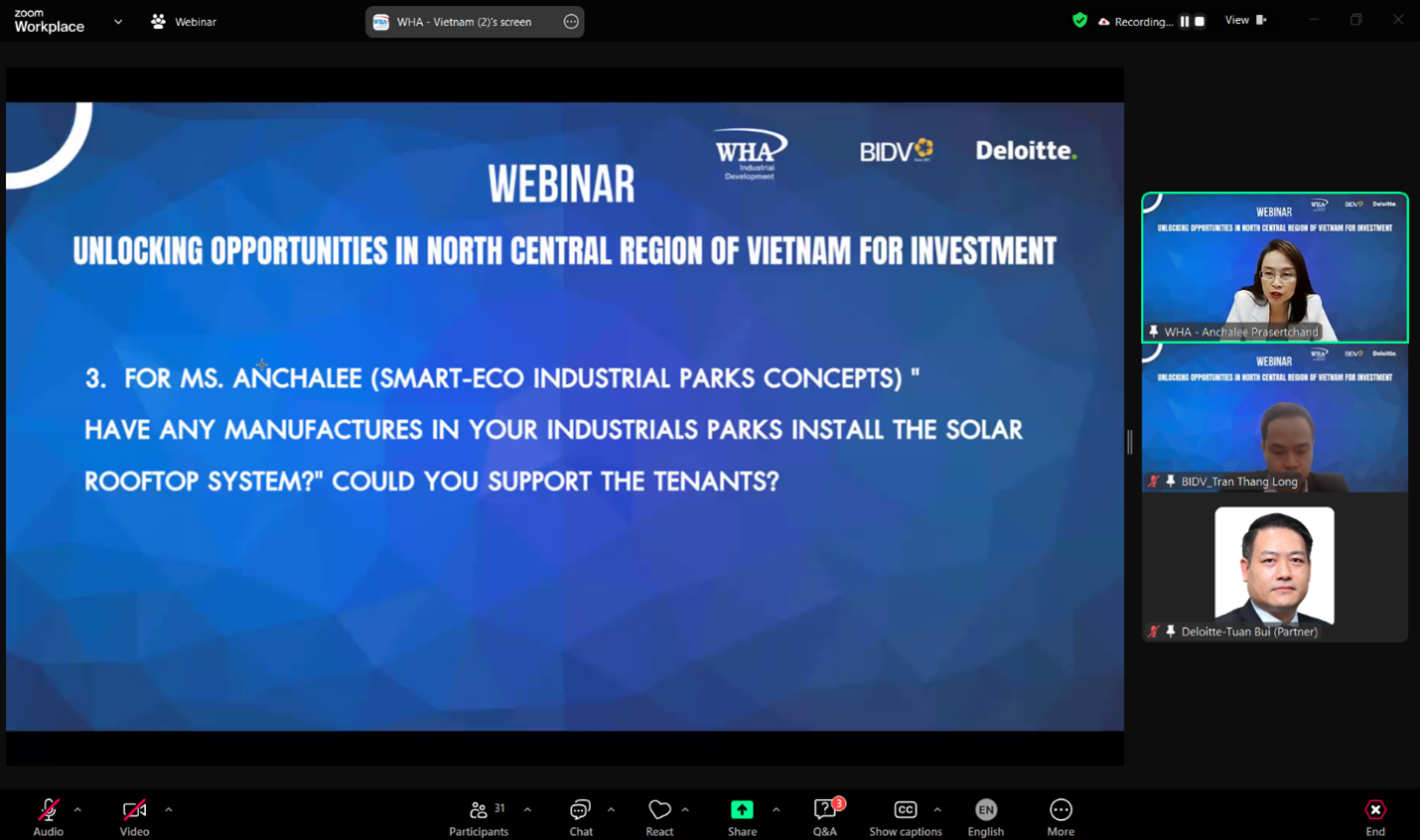
The event concluded with an engaging Q&A session, where participants posed insightful questions to the speakers. Key topics of discussion included the growth potential of investment in the North Central Region, the implications of the Global Minimum Tax on Vietnam’s tax policies, and WHA’s support for tenants seeking to install solar rooftop systems within their industrial parks.
The webinar reinforced the North Central Region’s position as an emerging industrial powerhouse, offering investors valuable insights and the confidence to explore new opportunities in this rapidly developing area.
Webinar Co-host Parties:
• BIDV (Bank for Investment and Development of Vietnam), established in 1957, is one of Vietnam's largest financial institutions. It offers a wide range of services, including corporate and retail banking, investment banking, and insurance. Known for its strong support of Vietnam’s economic growth, BIDV plays a key role in financing infrastructure and business development projects. With a nationwide network and global partnerships, BIDV is a trusted partner for both local and international investors, providing tailored financial solutions and market insights through its investment arm, BIDV Securities.
• Deloitte Vietnam, a member of Deloitte Touche Tohmatsu Limited, is one of the leading professional services firms in Vietnam, offering a wide range of services in audit, tax, consulting, and financial advisory. Established in 1991, Deloitte Vietnam has built a strong reputation for helping businesses navigate complex challenges and achieve sustainable growth. The firm serves clients across various sectors, including manufacturing, real estate, banking, and technology, providing innovative solutions tailored to the local market
• WHA Group is a leading logistics and industrial developer based in Thailand, specializing in industrial estates, logistics, utilities, and power solutions. With a strong presence across Southeast Asia, WHA Group provides comprehensive infrastructure and investment solutions to support businesses in various sectors, including manufacturing, automotive, electronics, and renewable energy. WHA’s commitment to innovation and sustainability is reflected in its development of eco-friendly industrial zones and smart infrastructure initiatives. WHA Vietnam, a subsidiary of WHA Group, plays a pivotal role in expanding the company’s footprint in Vietnam’s fast-growing market. WHA Vietnam focuses on developing modern industrial zones, such as the WHA Industrial Zone 1 – Nghe An, which integrates sustainable practices like smart power systems, water reclamation, and green mobility
Related News

CHARITY / EXHIBITION / OTHER EVENTS
INVESTMENT OPPORTUNITIES IN CA MAU PROVINCE: 96 PROJECTS AND 20 STRATEGIC PROJECTS
We are pleased to share with you information on investment projects currently seeking investors in Ca Mau Province. Should your esteemed company or association be interested, we kindly invite you to review the project information and complete the registration form via the links provided. The Ho Chi Minh City Investment and Trade Promotion Centre (ITPC) will consolidate the expressions of interest and facilitate connections with the leadership of Ca Mau Province at a meeting tentatively scheduled for 13 November 2026 in Ho Chi Minh City.
MEMBER CORNER / PROMOTIONS
BẰNG KIỀU LIVESHOW - A SYMPHONY OF LOVE UNDER THE GOLDEN GLOW
A masterclass in live music that takes the audience on a soulful journey through immortal love songs, guided by the peerless artistry and emotive storytelling of renowned singer Bằng Kiều. The highlight of the night is his seamless musical chemistry with special guest Triệu Hồng Ngọc, promising passionate and deeply resonant duets inside the magnificent Grand Ballroom.
INFRASTRUCTURE / CONSTRUCTION / LOGISTIC / PORT
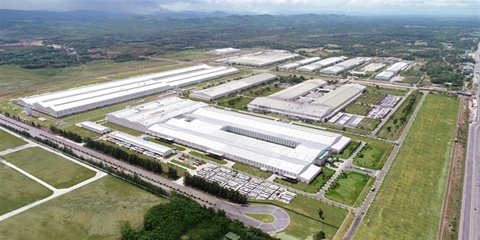
ĐÀ NẴNG GREEN-LIGHTS US$105 MILLION THAI DEVELOPMENT DEAL
The central city has approved an investment proposal by Thailand’s WHA Group to develop infrastructure for the 400ha WHA Đà Nẵng Industrial Park project on two communes of Thăng Bình and Đồng Dương, with an investment of more than VNĐ2.7 trillion (US$105 million). The city said it approved WHA Industrial Development International's status as an investor in the project, which is expected to take place between 2027 and 2034.
VIETNAM ECONOMY INVESTMENT
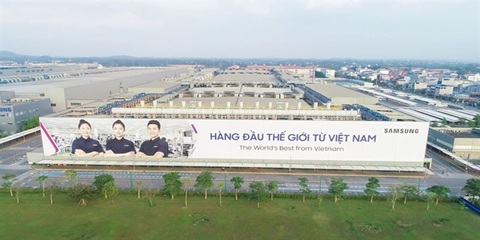
MOBILE PHONE EXPORTS RISE 20% TO $51.8 BILLION IN FIRST NINE MONTHS
Exports of mobile phones and components rose 20 per cent year-on-year to nearly US$51.8 billion in the first nine months of 2026, with China, the US and Republic of Korea accounting for more than half of the total. Shipments to the three markets reached a combined $26.18 billion, or 50.6 per cent of total exports of the product group during the period, according to data from the Vietnam Department of Customs under the Ministry of Finance.

INFRASTRUCTURE / CONSTRUCTION / LOGISTIC / PORT
VIỆT NAM-CAMBODIA TRADE GATHERS PACE TOWARDS $20 BILLION TARGET
Trade between Việt Nam and Cambodia continues to grow, remaining a bright spot and a key pillar of bilateral cooperation as the two countries aim to raise two-way trade to US$20 billion in the coming years. After setting a record of more than $11.3 billion last year, bilateral trade reached about $8.7 billion in the first eight months of this year, up 8.3 per cent year on year.
VIETNAM ECONOMY INVESTMENT
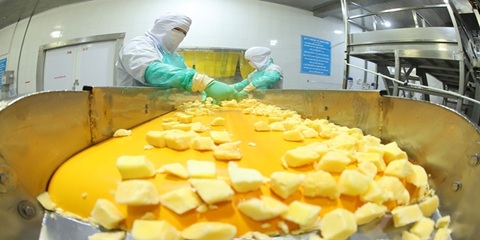
FRUIT AND VEGETABLE EXPORTS POISED TO HIT $10 BILLION IN 2026
Fruit and vegetable exports are on track to reach nearly US$10 billion in 2026, after rising 19.9 per cent year on year to nearly US$7.4 billion in the first nine months, driven by strong seasonal demand and abundant tropical fruit supplies. The Ministry of Agriculture and Environment said the growth reflected stronger international demand for fresh produce and processed agricultural products.
Events Sponsors






















