Want to be in the loop?
subscribe to
our notification
Business News
INVESTMENT OPPORTUNITIES SEEN IN RUBBER, STEEL INDUSTRIES IN 2025
The potential for transforming rubber land into industrial zones has emerged as a lucrative avenue for investment.
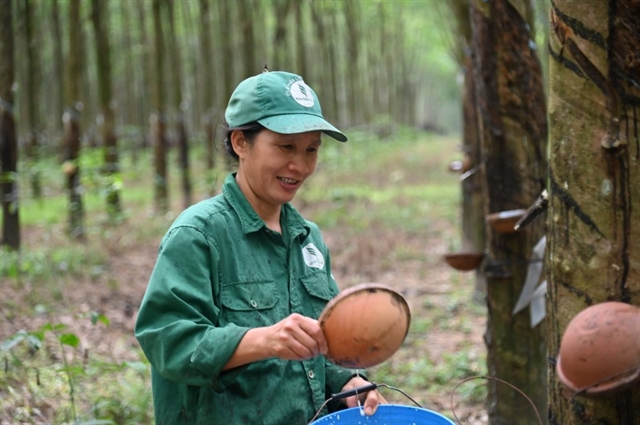
A Phuruco worker collecting latex at a rubber plantation. — Photo phr.vn
HÀ NỘI — As the Vietnamese stock market gears up for the challenges and opportunities of 2025, a wave of transformations is sweeping through various sectors, promising potential growth and profitability for savvy investors.
One such sector experiencing significant shifts is industrial real estate, particularly the conversion of rubber plantations into industrial zones, which is opening up new avenues for investment and development.
The strategic conversion of rubber plantations into industrial zones gained momentum towards the end of 2024, following the approval of provincial development plans and the enactment of new laws delegating responsibility to local authorities.
This strategic move is expected to unleash a wave of project approvals in 2025, bolstering the growth prospects for companies poised to benefit from this transition.
Enterprises in the rubber industry are now presented with a golden opportunity to repurpose their land holdings for industrial purposes.
For instance, Phước Hòa Rubber Company (Phuruco) has gathered approximately 15,000 hectares (ha) of rubber land in Bình Dương Province.
With the recent governmental approval of the Bình Dương provincial development plan for the period 2021-2030, Phuruco can potentially convert a significant portion of its rubber land (2,800ha) into industrial zones, paving the way for substantial industrial development.
According to Vietcap Securities JSC, Phuroco has the potential to expand around 650ha of industrial zone/industrial cluster land from 2026 to 2036 and convert 2,450ha of rubber plantation into industrial zone/industrial cluster and urban land between 2027 and 2040.
Moreover, its revenue stream in 2025 is poised for a significant upturn, fuelled by the VSIP III and Nam Tân Uyên Phase 2 expansion projects.
The company holds a 20 per cent stake in VSIP III as it transitions into a phase of robust revenue generation from land leasing.
With a 33 per cent ownership in the Nam Tân Uyên Phase 2 expansion project, slated to commence leasing activities in 2025 at rental rates ranging from US$180 to $190 per square metre, Phuroco is positioned for substantial cash flow.
Vietcombank Securities (VCBS) expects that the collective area of the VSIP III and Nam Tân Uyên Phase 2 expansion projects spans 1,300ha. Projections suggest that after 2025, Phuroco stands to realise an additional profit of VNĐ300- 400 billion (US$11.9-15.9 million) annually from these ventures.
Similarly, Đồng Phú Rubber JSC (Doruco) is strategically positioned in Bình Phước Province, an area with a high potential for attracting industrial growth. The company is eyeing the expansion of its industrial zones, such as the Bắc Đồng Phú Industrial Zone to 317ha and the Nam Đồng Phú Industrial Zone to 480ha, capitalising on the robust demand for industrial spaces in the region.
The Bắc Đồng Phú project currently spans 189ha with an occupancy rate of 99 per cent, while the Nam Đồng Phú project covers 69ha with an occupancy rate close to 100 per cent.
However, amid these promising prospects, there are also risks.
SSI Research has highlighted potential delays in obtaining permits for the expansion of industrial zones, which could pose challenges for companies like Doruco in 2025.
The conversion process from rubber plantations to industrial zones is a complex and time-consuming endeavour, subject to regulatory procedures and approvals that could impact the timelines and outcomes for these projects.
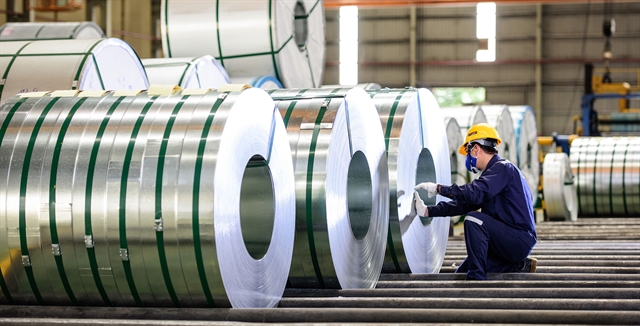
Inside a Hoa Sen Group warehouse. —Photo hoasengroup.vn
Steel’s recovery prospects
In parallel, the steel industry is also on investors' radar, with signs of a potential recovery on the horizon.
Driven by a projected 10 per cent increase in domestic steel demand in 2025 and bolstered by a resurgent real estate market and government infrastructure investments, companies like Hoa Sen Group are anticipated to witness a substantial uptick in profits.
SSI Research forecasts that the profit of Hoa Sen in fiscal year 2024-2025 will increase by 37 per cent to VNĐ700 billion. This growth momentum is driven by the recovery of steel prices and higher domestic consumption volume.
In fiscal year 2023-2024 (from October 1, 2023 to September 30, 2024), Hoa Sen recorded revenue of over VNĐ39.2 trillion, up 24.1 per cent year-on-year, while profit after tax was VNĐ514.67 billion, 16.12 times higher than the previous financial year.
Despite the positive outlook, there are inherent risks associated with investments in the steel sector.
Fluctuating steel prices, inventory management challenges and market uncertainties could pose obstacles to companies like Hoa Sen, necessitating a cautious approach to navigate through the complexities of the market.
The persistent downward trend in hot-rolled coil (HRC) steel prices from early 2024 through July 2024, followed by a period of stagnation, presents a notable risk to companies.
The price movement is particularly critical for steel manufacturers like Hoa Sen, potentially having resulted in operational losses during the fourth quarter of the 2023-2024 fiscal year. — VNS
Source: VNS
Related News

BANKING / FINANCE / INSURANCE / TAX
REMITTANCES TO HCM CITY RISE NEARLY 40% IN Q3
Remittances to HCM City reached more than US$2.83 billion in the third quarter of this year, up 39.5 per cent from the previous quarter and 3.6 per cent year-on-year. This was the first quarter showing positive annual growth this year, helping narrow the decline in remittance inflows over the first nine months. According to the State Bank of Vietnam (SBV)’s Regional Branch 2, remittances transferred to HCM City through credit institutions and economic organisations totalled $2.835 billion in Q3, an increase of more than $802 million from the previous quarter.

TECHNOLOGY
TECH SECTOR GROWTH OPENS UP OPPORTUNITIES FOR VIỆT NAM TO GO GLOBAL
The growth of the electronics, semiconductor and high-tech sectors worldwide is opening up a variety of opportunities for Vietnamese enterprises to integrate more deeply into the global supply chain. However, to become suppliers for these corporations, domestic enterprises must meet rigorous standards regarding quality, technology, productivity and order fulfilment capabilities.
VIETNAM ECONOMY INVESTMENT
FOREIGN INVESTORS SEEKING A SYNCHRONISED MANUFACTURING ECOSYSTEM
Instead of focusing only on land costs and incentives as usual, foreign investors are seeking a synchronised manufacturing ecosystem, from stable power supply and logistics to shared infrastructure and the convenience of completing residence procedures for experts to serve their long-term investment in the country.
MEMBER CORNER / PROMOTIONS
SENTRYSAFE FHW40200 – PROTECT YOUR VALUABLES, ENJOY PEACE OF MIND!
Looking for a reliable solution to protect your important documents, cash, and valuables from fire and water damage? Genuine SENTRYSAFE - Reliable protection for your valuables and peace of mind! Contact Sen Wai Vietnam for more information and personalized product recommendations.
PROPERTY / INDUSTRIAL ZONE
HCM CITY ATTRACTS US$5.7 BILLION INTO EXPORT PROCESSING AND INDUSTRIAL ZONES
HCM City attracted US$5.7 billion in domestic and foreign investment into its export processing and industrial zones during the first nine months of 2026. The figure exceeded the city's full-year target by 31 per cent, highlighting strong momentum in high-quality industrial investment under Resolution No.10-NQ/TW. Total investment reached 131 per cent of the 2026 target of $4.25 billion and represented a 29 per cent increase compared with the same period in 2025, according to the city's Export Processing and Industrial Zones Authority (HEPZA).
INFRASTRUCTURE / CONSTRUCTION / LOGISTIC / PORT
DONG THAP PROVINCE STEPS UP INDUSTRIAL EXPANSION AND INFRASTRUCTURE CONNECTIVITY
Accelerating public investment, strengthening inter-regional connectivity, and expanding industrial land are helping Dong Thap efficiently bolster competitiveness and drive economic growth. Following the 2025 merger of the former Dong Thap and Tien Giang provinces, the expanded Dong Thap province in the Mekong Delta faces mounting pressure to accelerate infrastructure development and strengthen connectivity among local economic zones, urban areas, industrial parks (IPs), and production centres.
Events Sponsors






















