Want to be in the loop?
subscribe to
our notification
Business News
INVESTMENT FUNDS REGAIN POSITIVE RETURNS ON MARKET RECOVERY
After bottoming out in early April, the benchmark index reclaimed all losses incurred during the tariff-triggered volatility by the end of May. The rebound has buoyed equity funds, restoring previously negative returns to solid profits.
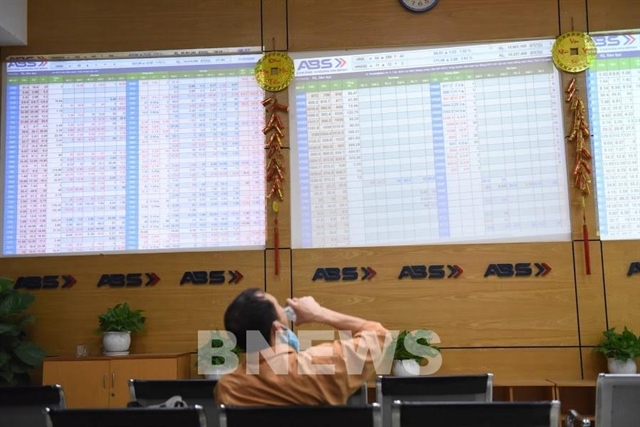
An investor tracking the market's movement on the trading floor of a securities firm in Hà Nội. — Photo bnews.vn
HÀ NỘI — Vietnamese equity mutual funds have swung into positive territory amid the VN-Index’s recent recovery.
After bottoming out in early April, the benchmark index reclaimed all losses incurred during the tariff-triggered volatility by the end of May. The rebound has buoyed equity funds, restoring previously negative returns to solid profits.
Between April 10 and May 31, several open-ended equity funds delivered substantial returns.
Notably, DC Dynamic Securities Fund (DCDS) yielded 26.4 per cent, Viet Capital Discovery Fund (VCAMDF) 26.3 per cent and VCBF Blue Chip Fund (VCBF‑BCF) 23.5 per cent, while MB Capital Value Fund (MBVF) and BaoViet Equity Dynamic Open-Ended Fund (BVFED) reported 20.2 per cent and 20.8 per cent, respectively.
Other strong performers included VCBF Active Income Fund (VCBF‑AIF), VCBF Midcap Growth Fund (VCBF‑MGF), United Vietnam ESG Equity Fund (UVEEF) and VinaCapital Equity Special Access Fund (VESAF), all exceeding 20 per cent.
Despite these stellar results, most equity funds remained in single-digit growth territory, as much of the VN-Index’s rebound has been driven by large-cap real estate stocks like Vingroup (VIC), Vinhomes (VHM) and Vincom Retail (VRE), sectors that many funds underweighted due to valuation risks following earlier corrections.
Meanwhile, holdings in core sectors such as FPT Corporation (FPT), which dropped over 30 per cent from its peak, and fragmented performances in the banking sector added to the drag on fund performance.
Over a five-year horizon, leading equity mutual funds have consistently outperformed the VN-Index’s average annual return of 9.2 per cent, data from Fmarket showed.
VESAF delivered an annualised 21.8 per cent, followed by SSI Sustainable Competitive Advantage Open-Ended Fund (SSISCA) at 18.8 per cent, DCDS at 18 per cent, Vinacapital Equity Opportunity Fund (VEOF) at 17.8 per cent and VCBF‑BCF at 17.3 per cent.
These results underscore disciplined, long-term management strategies and robust portfolio governance.
At a May investor conference, VinaCapital’s Senior Investment Director Đinh Đức Minh highlighted Việt Nam’s entry into 'Renewal 2.0' -- a reform era aimed at unlocking institutions and spurring the private sector.
Resolution 68 sets an ambitious private sector growth target of 10–12 per cent annually, expecting it to contribute over half of GDP, foster two million enterprises and bolster 20 firms entering into global value chains.
Minh estimates that ten well-selected, market-leading domestic stocks could feasibly deliver a 15 per cent compound annual growth rate over the next 5–10 years. He emphasised the importance of value selection, sound growth potential and disciplined holding periods — arguments that support investor engagement via professionally managed funds.
The domestic stock market is currently trading at a price to earnings (P/E) ratio near 13.1, which is below its five-year average, signalling a favourable valuation for long-term investors.
In response to trade‑tariff uncertainties, funds have implemented scenario-based strategies.
VinaCapital anticipates corporate earnings could still grow around 13 per cent annually, even under a 20 per cent tariff shock.
Bordier MB Flagship Fund (BMFF), the top performer over the past year, views geopolitical and exchange-rate risks as short-term noise, unlikely to derail the dominant upward market trend.
For 2025, BMFF plans to capitalise on periodic market pullbacks, maintaining high equity allocations.
The fund aims to accumulate quality growth stocks at discounted prices, restructure portfolios when markets elevate beyond rational ranges and deploy capital tactically.
Dragon Capital’s DCDS also exemplified active positioning by reducing cash from 21.2 per cent in March to 10 per cent in April to redeploy into equities amid attractive valuations, signalling renewed investor confidence. — BIZHUB/VNS
Source: VNS
Related News

BANKING / FINANCE / INSURANCE / TAX
REMITTANCES TO HCM CITY RISE NEARLY 40% IN Q3
Remittances to HCM City reached more than US$2.83 billion in the third quarter of this year, up 39.5 per cent from the previous quarter and 3.6 per cent year-on-year. This was the first quarter showing positive annual growth this year, helping narrow the decline in remittance inflows over the first nine months. According to the State Bank of Vietnam (SBV)’s Regional Branch 2, remittances transferred to HCM City through credit institutions and economic organisations totalled $2.835 billion in Q3, an increase of more than $802 million from the previous quarter.

TECHNOLOGY
TECH SECTOR GROWTH OPENS UP OPPORTUNITIES FOR VIỆT NAM TO GO GLOBAL
The growth of the electronics, semiconductor and high-tech sectors worldwide is opening up a variety of opportunities for Vietnamese enterprises to integrate more deeply into the global supply chain. However, to become suppliers for these corporations, domestic enterprises must meet rigorous standards regarding quality, technology, productivity and order fulfilment capabilities.

VIETNAM ECONOMY INVESTMENT
FOREIGN INVESTORS SEEKING A SYNCHRONISED MANUFACTURING ECOSYSTEM
Instead of focusing only on land costs and incentives as usual, foreign investors are seeking a synchronised manufacturing ecosystem, from stable power supply and logistics to shared infrastructure and the convenience of completing residence procedures for experts to serve their long-term investment in the country.

MEMBER CORNER / PROMOTIONS
SENTRYSAFE FHW40200 – PROTECT YOUR VALUABLES, ENJOY PEACE OF MIND!
Looking for a reliable solution to protect your important documents, cash, and valuables from fire and water damage? Genuine SENTRYSAFE - Reliable protection for your valuables and peace of mind! Contact Sen Wai Vietnam for more information and personalized product recommendations.

PROPERTY / INDUSTRIAL ZONE
HCM CITY ATTRACTS US$5.7 BILLION INTO EXPORT PROCESSING AND INDUSTRIAL ZONES
HCM City attracted US$5.7 billion in domestic and foreign investment into its export processing and industrial zones during the first nine months of 2026. The figure exceeded the city's full-year target by 31 per cent, highlighting strong momentum in high-quality industrial investment under Resolution No.10-NQ/TW. Total investment reached 131 per cent of the 2026 target of $4.25 billion and represented a 29 per cent increase compared with the same period in 2025, according to the city's Export Processing and Industrial Zones Authority (HEPZA).

INFRASTRUCTURE / CONSTRUCTION / LOGISTIC / PORT
DONG THAP PROVINCE STEPS UP INDUSTRIAL EXPANSION AND INFRASTRUCTURE CONNECTIVITY
Accelerating public investment, strengthening inter-regional connectivity, and expanding industrial land are helping Dong Thap efficiently bolster competitiveness and drive economic growth. Following the 2025 merger of the former Dong Thap and Tien Giang provinces, the expanded Dong Thap province in the Mekong Delta faces mounting pressure to accelerate infrastructure development and strengthen connectivity among local economic zones, urban areas, industrial parks (IPs), and production centres.
Events Sponsors






















