Want to be in the loop?
subscribe to
our notification
Business News
IMPROVING INFRASTRUCTURE AND ECONOMIC CONNECTIVITY IN NORTHERN AND CENTRAL PROVINCES
The Asian Development Bank (ADB) has approved two loans with a total value of $299 million for Vietnam, according to the bank's announcement on December 18.
The first loan worth $150 million aims to improve economic connectivity and raise living standards in four of Vietnam’s northeastern provinces by enhancing basic infrastructure and services. The assistance is expected to help over 212,000 people and be completed by the first quarter of 2023. The total cost of the project is $190.3 million, including Vietnam’s counterpart fund of $40.3 million.
According to the assessment of ADB, the four provinces of Bac Kan, Cao Bang, Ha Giang, and Lang Son have significant potential to become trade hubs due to their strategic location at the nexus of the People’s Republic of China, Hanoi, Haiphong Port, and the ADB-supported Greater Mekong Subregion North-South Economic Corridor. However, these potentials are yet to be fully realised.
The project to construct basic infrastructure for inclusive growth in the northeastern provinces will help unlock the binding constraints through the development of basic infrastructure across key sectors, including trade, transport, health, and agriculture.
The project will improve road connectivity among the provinces by upgrading about 121 kilometres of provincial and 144km of district roads, provide rural water supply, benefiting 42,300 people and improving the agricultural value chain infrastructure in Lang Son province through farm-to-market connectivity and support to local businesses.
The second loan worth $149 million aims to help improve basic infrastructure services and promote inclusive and sustainable economic growth that will benefit over one million people in four provinces in the north central coastal region of Vietnam.
ADB’s assistance for the project on constructing basic infrastructure for inclusive growth in the north central provinces includes a regular loan of $52 million and a concessional loan worth $97 million. Both loans will be financed from ordinary capital resources where most of ADB’s lending come from. The total cost of the project is $203.52 million, with Vietnam contributing $54.52 million.
Economic development in the provinces of Ha Tinh, Nghe An, Quang Binh, and Quang Tri has been constrained by the fragmented coverage of basic infrastructure, with the 2015 poverty rate reaching 13 per cent compared to the 7 per cent national average. Moreover, the provinces are extremely vulnerabile to weather-related disasters and are predicted to have the country’s highest increase in annual mean temperature at 1.7 per cent and annual rainfall shooting up by 20 per cent.
To address these issues, the project will improve connectivity among the provinces by upgrading and constructing about 214km of climate-resilient provincial and district roads which will benefit more than 900,000 beneficiaries. It will boost business development through the construction and upgrading of rural water supply, flood protection, irrigation, and port services.
Source: VIR
Related News

MEMBER CORNER / PROMOTIONS
SENTRYSAFE CHW20201 - EFFECTIVE WATER RESISTANCE, MAXIMUM PROTECTION
In unexpected flooding situations, the most important thing is to keep your valuables dry and intact. SentrySafe CHW20201 is specially designed with superior water-resistant capabilities, helping protect documents, cash, and important belongings even when fully submerged. Proven in real testing: After water submersion, the documents inside remain dry - undamaged.

MEMBER CORNER / PROMOTIONS
AN ELECTRIFYING NIGHT WITH THE "QUEEN OF DANCE" THU MINH AT THE GRAND HO TRAM!
The stage at The Grand Ballroom is set to catch fire as Vietnam’s undisputed "Queen of Dance," Thu Minh, takes the spotlight. Renowned for her powerhouse vocals, magnetic stage presence, and sultry, high-energy performances, Thu Minh promises an evening of pure musical euphoria. The energy escalates with an exclusive appearance by special guest and The Voice champion, Vu Thao My.
HR / LABOUR/ EMPLOYMENT
HIGH-QUALITY HUMAN RESOURCES NEEDED TO ATTRACT NEW TECH INVESTMENT CAPITAL
Besides infrastructure, Việt Nam must also rapidly develop a highly skilled workforce to attract investment in AI, semiconductors and advanced manufacturing, experts have said. Don Lam, CEO and co-founder of investment management company VinaCapital, said that global technology investors were increasingly looking at the readiness of the entire ecosystem, with high-quality human resources a decisive factor.

HR / LABOUR/ EMPLOYMENT
HIRING OUTLOOK STRENGTHENS IN Q4 AS SKILLS SHORTAGES PERSIST
Hiring intentions among employers in Việt Nam strengthened in the fourth quarter, with 52 per cent of surveyed companies planning to increase headcount between October and December, according to a ManpowerGroup survey released this week. Việt Nam's hiring outlook was stronger than the Asia Pacific and Middle East (APME) regional average of 33 per cent and the global average of 29 per cent, ranking third in the region and 11th globally among 42 markets surveyed.

BANKING / FINANCE / INSURANCE / TAX
LARGE BANKS FORECAST TO GAIN HIGHER PROFITABILITY IN H2 2026
The return on average assets (ROAA) of the banking sector will likely remain stable at around 1.5 per cent in the second half of 2026, but profitability divergence among banks will increase, with large banks outperforming peers on stronger margins and diversified earnings, analysts forecast. In a recent report on the banking sector, analysts from the Vietnam Investors Service Rating said the sector’s ROAA rose by 10 basis points quarter-on-quarter to 1.51 per cent in the first half of this year, driven by net interest margin (NIM) improvements at some State-owned banks and large private banks.
GARMENT / TEXTILE
VIỆT NAM'S FOOTWEAR, BAG EXPORTS TO US TOP $8 BILLION IN EIGHT MONTHS
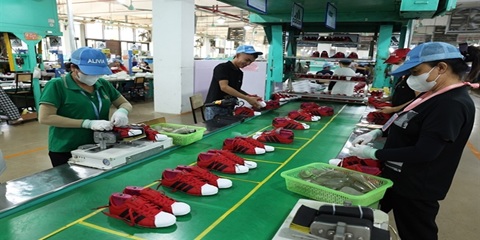
Việt Nam's exports of footwear and handbags to the US exceeded US$8 billion in the first eight months of 2026, as the US and EU remained the country's biggest markets despite sluggish growth in footwear shipments. Exports from Việt Nam's leather and footwear sector reached more than $2.45 billion in August, down 9 per cent from July but up 3 per cent from a year earlier, according to preliminary statistics.
Events Sponsors






















