Want to be in the loop?
subscribe to
our notification
Business News
HCMC’S JAN-OCT BUDGET REVENUE MEETS 97.2% OF FULL-YEAR TARGET
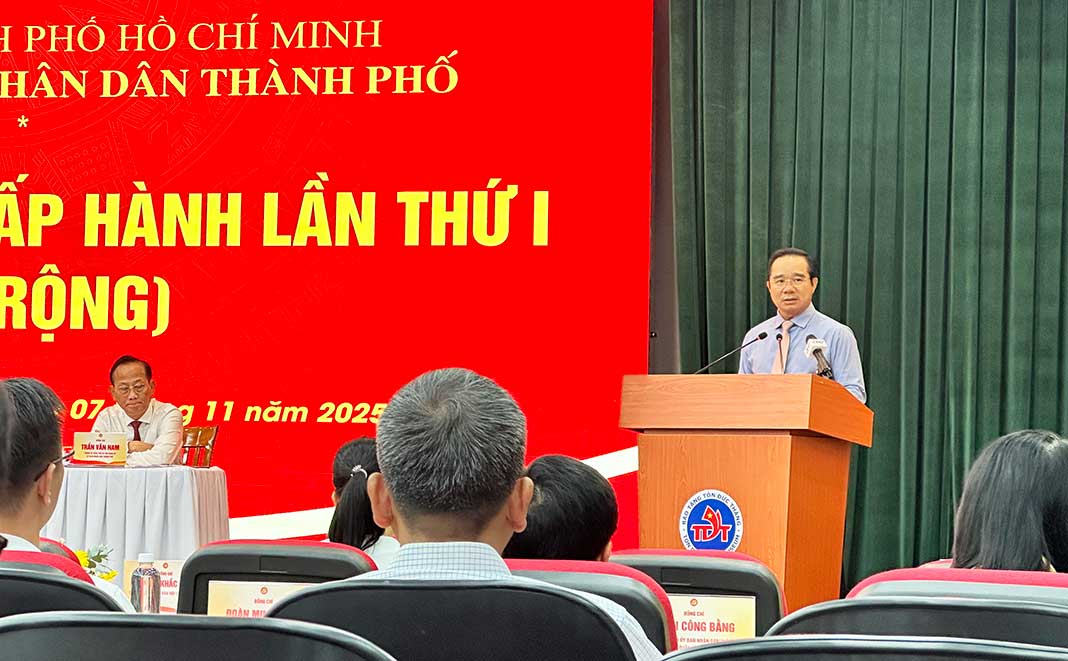
Nguyen Van Duoc, chairman of the HCMC People’s Committee, speaks at the first meeting of the Executive Committee of the 2025-2030 Party Committee of the HCMC People’s Committee today – PHOTO: HUU CHUONG
HCMC – Total budget revenue of HCMC in the first 10 months of this year amounted to VND652 trillion, meeting 97.2% of the target for all of 2025 set by the central Government. By the end of the year, the southern metropolis expects to beat the full-year target.
Speaking at the first meeting of the Executive Committee of the 2025-2030 Party Committee of the HCMC People’s Committee today, Nguyen Van Duoc, chairman of the HCMC People’s Committee, said the city would absolutely obtain higher budget revenue than expected for this year if each individual or each organization showed a sense of responsibility for getting their jobs done.
The investment environment has remained attractive, he noted, adding that at a recent investor conference, investors expressed a positive view on HCMC’s investment climate.
In the first 10 months of this year, the city continued to lead the country in foreign direct investment (FDI) attraction, with more than US$7.2 billion registered, including US$2 billion committed to the high-tech, semiconductor, and big data sectors.
Chairman Duoc, who is also secretary of the Party Committee of the HCMC People’s Committee, said that in order to achieve gross regional domestic product (GRDP) growth of 8.5% this year, the city would have to take drastic measures to bolster economic and investment activities.
In the fourth quarter, the city would need to obtain growth of as high as 12.4% if it is to ensure GRDP growth of 8.5% for this year. Duoc said this is a tough challenge for the city under current economic conditions.
To realize the GRDP growth target, he said, the city will have no other choice but to boost public investment disbursement.
Public investment disbursement so far this year has met nearly 60% of the 2025 goal while the city planned to obtain 75% in the third quarter and 100% in the fourth quarter, he said, so department leaders would have to clarify reasons for lower-than-expected disbursement and propose breakthrough solutions in the rest of the year.
As for public investment disbursement, Tran Quang Lam, director of the HCMC Department of Construction, said that public investment disbursement largely depends on land compensation and land clearance progress.
The city spent nearly half of the previous term without making bold preparations for new projects, leading to bottlenecks toward the end of the term when new projects required site clearance and compensation, Lam noted.
To address this, right at the start of the new term, the city focuses on investment preparation to ensure a pipeline of projects ready for construction early in the term, he said.
Concerning major infrastructure projects partially or fully funded by the state budget, Tran Quang Lam, director of the HCMC Department of Construction, said that aside from focusing on the Beltway No. 3 project — which is expected to reach basic completion by the end of this year and to be opened to traffic in 2026 — HCMC is also prioritizing the Beltway No. 4, the HCMC–Moc Bai Expressway, and metro lines.
Regarding the metro line which links downtown HCMC and the coastal commune of Can Gio and which is being studied by Vietnamese diversified conglomerate Vingroup, the Department of Finance is appraising the investment proposal before submitting it to the city government, while the Department of Construction is guiding the investor through subsequent administrative steps. The project is expected to break ground by the end of this year after amendments to the National Assembly’s Resolution 98 on special policies for HCMC are approved.
Other metro lines funded by major corporations are also being implemented with close coordination among relevant departments and agencies.
Source: The Saigon Times
Related News

BANKING / FINANCE / INSURANCE / TAX
REMITTANCES TO HCM CITY RISE NEARLY 40% IN Q3
Remittances to HCM City reached more than US$2.83 billion in the third quarter of this year, up 39.5 per cent from the previous quarter and 3.6 per cent year-on-year. This was the first quarter showing positive annual growth this year, helping narrow the decline in remittance inflows over the first nine months. According to the State Bank of Vietnam (SBV)’s Regional Branch 2, remittances transferred to HCM City through credit institutions and economic organisations totalled $2.835 billion in Q3, an increase of more than $802 million from the previous quarter.

TECHNOLOGY
TECH SECTOR GROWTH OPENS UP OPPORTUNITIES FOR VIỆT NAM TO GO GLOBAL
The growth of the electronics, semiconductor and high-tech sectors worldwide is opening up a variety of opportunities for Vietnamese enterprises to integrate more deeply into the global supply chain. However, to become suppliers for these corporations, domestic enterprises must meet rigorous standards regarding quality, technology, productivity and order fulfilment capabilities.

VIETNAM ECONOMY INVESTMENT
FOREIGN INVESTORS SEEKING A SYNCHRONISED MANUFACTURING ECOSYSTEM
Instead of focusing only on land costs and incentives as usual, foreign investors are seeking a synchronised manufacturing ecosystem, from stable power supply and logistics to shared infrastructure and the convenience of completing residence procedures for experts to serve their long-term investment in the country.
MEMBER CORNER / PROMOTIONS
SENTRYSAFE FHW40200 – PROTECT YOUR VALUABLES, ENJOY PEACE OF MIND!
Looking for a reliable solution to protect your important documents, cash, and valuables from fire and water damage? Genuine SENTRYSAFE - Reliable protection for your valuables and peace of mind! Contact Sen Wai Vietnam for more information and personalized product recommendations.

PROPERTY / INDUSTRIAL ZONE
HCM CITY ATTRACTS US$5.7 BILLION INTO EXPORT PROCESSING AND INDUSTRIAL ZONES
HCM City attracted US$5.7 billion in domestic and foreign investment into its export processing and industrial zones during the first nine months of 2026. The figure exceeded the city's full-year target by 31 per cent, highlighting strong momentum in high-quality industrial investment under Resolution No.10-NQ/TW. Total investment reached 131 per cent of the 2026 target of $4.25 billion and represented a 29 per cent increase compared with the same period in 2025, according to the city's Export Processing and Industrial Zones Authority (HEPZA).

INFRASTRUCTURE / CONSTRUCTION / LOGISTIC / PORT
DONG THAP PROVINCE STEPS UP INDUSTRIAL EXPANSION AND INFRASTRUCTURE CONNECTIVITY
Accelerating public investment, strengthening inter-regional connectivity, and expanding industrial land are helping Dong Thap efficiently bolster competitiveness and drive economic growth. Following the 2025 merger of the former Dong Thap and Tien Giang provinces, the expanded Dong Thap province in the Mekong Delta faces mounting pressure to accelerate infrastructure development and strengthen connectivity among local economic zones, urban areas, industrial parks (IPs), and production centres.
Events Sponsors






















