Want to be in the loop?
subscribe to
our notification
Business News
HÀ NỘI, HCM CITY, HẢI PHÒNG, AND ĐÀ NẴNG LEAD 5-YEAR REAL ESTATE CYCLE
Việt Nam’s property market continues to show resilience amid economic volatility, with major cities remaining bright spots.
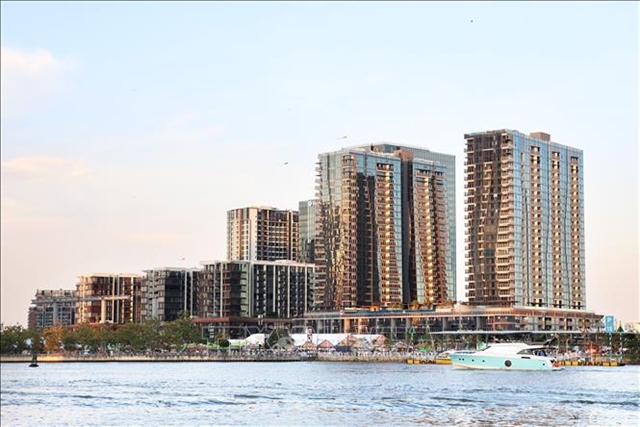
HCM City’s real estate market shows clear signs of revival, with stronger growth in both prices and buyer interest.— VNA/VNS Photo
HCM CITY — Việt Nam’s property market continues to show resilience amid economic volatility, with major cities remaining bright spots.
According to property technology platform Batdongsan.com.vn, Hà Nội, HCM City, Hải Phòng, and Đà Nẵng have demonstrated strong appeal, recording strong price growth throughout the 2021–25 cycle.
The findings were unveiled at the Vietnam Real Estate Market Overview Q3/2025 seminar held online on October 7, which drew strong interest from industry experts, investors and real estate businesses.
Hà Nội led with a 112 per cent increase in property prices over five years, followed by Hải Phòng (71 per cent), Đà Nẵng (53 per cent), and HCM City (42 per cent).
In the central region, Đà Nẵng, after merging with Quảng Nam Province, saw a strong rebound in Q3, with buyer interest up 24 per cent in the former Đà Nẵng and 58 per cent in the former Quảng Nam.
Prices rose by 30 per cent and 32 per cent, respectively, driven mainly by investors from other localities, including Hà Nội and HCM City.
Land and apartment prices in Đà Nẵng have soared by 68 per cent and 50 per cent from Q1/2023.
Hà Nghiệm, director of Batdongsan.com.vn’s Đà Nẵng branch, said land prices remain only slightly above their 2019 peak, meaning there is room for growth.
Hải Phòng has also entered a clear recovery phase.
Nguyễn Thị Ngọc Thương, director of Batdongsan.com.vn’s Hải Phòng branch, said the merger with Hải Dương has made the former city Việt Nam’s third-largest economy, creating a new national growth hub.
It has maintained a 4.6 per cent rental yield, second only to Bắc Ninh, and supply is expanding in the mid- and high-priced segments, she said.
The city’s mega coastal urban model that integrates industry, logistics, housing, seaport, commercial, and service functions under one large-scale administrative structure continues to attract both investors and new residents, paving the way for diverse real estate from industrial and commercial assets to apartments and shophouses, she added.
In Hà Nội, property prices continue to rise this year, though at a slower pace.
Listing prices are up 13 per cent compared with a 39 per cent jump in 2024.
Apartments remain the most active segment, but affordability challenges are emerging, especially in premium districts.
HCM City market
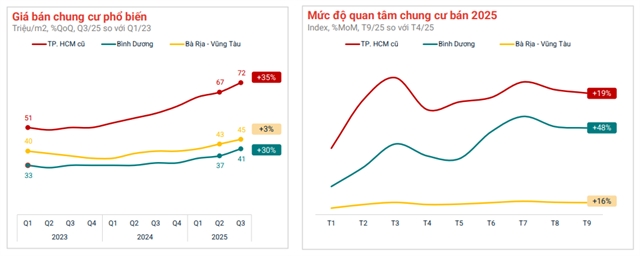
Average apartment prices in the former HCM City, Bình Dương and Bà Rịa-Vũng Tàu. — Source batdongsan.com.vn
HCM City’s real estate market also shows clear signs of revival, with stronger growth in both prices and buyer interest.
Batdongsan.com.vn’s Q3 data shows average listing prices climbed to VNĐ99 million per square metre, the highest in two years, while property searches reached record highs, reflecting expectations of a new growth cycle.
The apartment segment has been most active.
In the former HCM City area, prices averaged VNĐ72 million per sq.m in Q2, up 35 per cent from early 2023. In the former Bình Dương Province, they rose by 30 per cent to VNĐ41 million.
Buyer interest in these two areas increased by 19 per cent and 48 per cent, respectively, signalling real demand.
The erstwhile Bà Rịa–Vũng Tàu Province saw slow growth and declining buyer interest, underscoring the growing divergence among satellite markets.
The land segment in HCM City and Bình Dương has also recovered after several quiet quarters.
Average land prices rose by 6 per cent from the second quarter to VNĐ69 million per square metre in HCM City and 5 per cent to VNĐ21 million in Bình Dương.
“After a period of waiting and observation, HCM City is bouncing back strongly, with improving liquidity driven by both end-user and investment demand,” Đinh Minh Tuấn, southern regional director of Batdongsan.com.vn, said.
In Hà Nội, prices remain high but buyer demand has cooled, with capital still focused on near-central high-end projects, he said.
“This divergence between the two biggest markets reflects a broader national recovery trend.”
Speaking about the prospects for Q4, batdongsan.com.vn said 60 per cent of surveyed agents believe the market will continue to grow, with 17 per cent expecting strong growth, a third anticipating stability, while only 6 per cent are concerned about a potential short-term decline.
The apartment segment is considered the most promising in the next six months, with 36 per cent of respondents expecting a rise, followed by townhouses and land, indicating that capital will continue to focus on real demand and highly liquid segments. — VNS
Source: VNS
Related News

MEMBER CORNER / PROMOTIONS
SENTRYSAFE CHW20201 - EFFECTIVE WATER RESISTANCE, MAXIMUM PROTECTION
In unexpected flooding situations, the most important thing is to keep your valuables dry and intact. SentrySafe CHW20201 is specially designed with superior water-resistant capabilities, helping protect documents, cash, and important belongings even when fully submerged. Proven in real testing: After water submersion, the documents inside remain dry - undamaged.
MEMBER CORNER / PROMOTIONS
AN ELECTRIFYING NIGHT WITH THE "QUEEN OF DANCE" THU MINH AT THE GRAND HO TRAM!
The stage at The Grand Ballroom is set to catch fire as Vietnam’s undisputed "Queen of Dance," Thu Minh, takes the spotlight. Renowned for her powerhouse vocals, magnetic stage presence, and sultry, high-energy performances, Thu Minh promises an evening of pure musical euphoria. The energy escalates with an exclusive appearance by special guest and The Voice champion, Vu Thao My.
HR / LABOUR/ EMPLOYMENT
HIGH-QUALITY HUMAN RESOURCES NEEDED TO ATTRACT NEW TECH INVESTMENT CAPITAL
Besides infrastructure, Việt Nam must also rapidly develop a highly skilled workforce to attract investment in AI, semiconductors and advanced manufacturing, experts have said. Don Lam, CEO and co-founder of investment management company VinaCapital, said that global technology investors were increasingly looking at the readiness of the entire ecosystem, with high-quality human resources a decisive factor.

HR / LABOUR/ EMPLOYMENT
HIRING OUTLOOK STRENGTHENS IN Q4 AS SKILLS SHORTAGES PERSIST
Hiring intentions among employers in Việt Nam strengthened in the fourth quarter, with 52 per cent of surveyed companies planning to increase headcount between October and December, according to a ManpowerGroup survey released this week. Việt Nam's hiring outlook was stronger than the Asia Pacific and Middle East (APME) regional average of 33 per cent and the global average of 29 per cent, ranking third in the region and 11th globally among 42 markets surveyed.

BANKING / FINANCE / INSURANCE / TAX
LARGE BANKS FORECAST TO GAIN HIGHER PROFITABILITY IN H2 2026
The return on average assets (ROAA) of the banking sector will likely remain stable at around 1.5 per cent in the second half of 2026, but profitability divergence among banks will increase, with large banks outperforming peers on stronger margins and diversified earnings, analysts forecast. In a recent report on the banking sector, analysts from the Vietnam Investors Service Rating said the sector’s ROAA rose by 10 basis points quarter-on-quarter to 1.51 per cent in the first half of this year, driven by net interest margin (NIM) improvements at some State-owned banks and large private banks.
GARMENT / TEXTILE
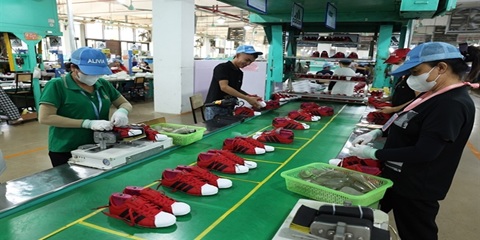
VIỆT NAM'S FOOTWEAR, BAG EXPORTS TO US TOP $8 BILLION IN EIGHT MONTHS
Việt Nam's exports of footwear and handbags to the US exceeded US$8 billion in the first eight months of 2026, as the US and EU remained the country's biggest markets despite sluggish growth in footwear shipments. Exports from Việt Nam's leather and footwear sector reached more than $2.45 billion in August, down 9 per cent from July but up 3 per cent from a year earlier, according to preliminary statistics.
Events Sponsors






















