Want to be in the loop?
subscribe to
our notification
Business News
GREEN TRANSFORMATION IN LOGISTICS IS A SMART PATH TO SUSTAINABILITY
The green transformation in logistics has moved from being a mere trend to an unavoidable imperative. It affects not only a company’s competitiveness, but also its very survival.
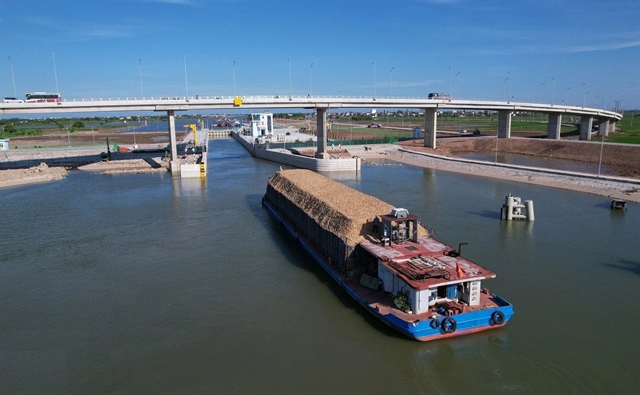
A view of Nghĩa Hưng Canal, dubbed the 'Panama Canal of Việt Nam'. — Photo vlr.vn
HÀ NỘI — Green transformation is not simply about environmental responsibility, but is also a smart approach to enhance competitiveness and ensure long-term survival in a rapidly evolving market landscape, according to experts.
The global economy is undergoing significant shifts. Trade routes are being restructured, supply chains reshaped and the demand for faster, more efficient logistics is growing.
Meanwhile, international regulations are tightening rapidly. From the European Union’s Fit for 55 Package, which aims to reduce carbon emissions drastically by 2030, to the International Maritime Organization (IMO)'s roadmap targeting carbon neutrality in shipping, logistics companies worldwide must 'green' their operations.
The green transformation in logistics has moved from being a mere trend to an unavoidable imperative. It affects not only a company’s competitiveness, but also its very survival.
According to Koen Soenens, board member of the Transportation and Logistics Sector Committee at the European Chamber of Commerce (EuroCham) in Việt Nam, the sector is under considerable pressure, especially as companies seek deeper integration with the European market.
As a representative from DEEP C Industrial Park and also representing the European business community operating in Việt Nam, Soenens also said logistics serves as the heart of the economy, connecting production, circulation and distribution. Yet, the industry must evolve rapidly to meet sustainable development goals.
European businesses operating in Việt Nam have begun adopting green initiatives, such as solar power installations in warehouses, eco-friendly delivery fleets and digital tools that optimise routes to reduce fuel consumption and emissions.
These efforts are not just temporary trends; they are strategic choices aimed at long-term efficiency and competitiveness, Soenens said.
However, challenges remain. Việt Nam’s logistics infrastructure is still fragmented, and inconsistent policies complicate widespread adoption of green practices.
Soenens has also stressed the importance of coordinated efforts among businesses, Government agencies and stakeholders to build a sustainable logistics ecosystem. With increased awareness, financing, skills development and policy alignment, Việt Nam can accelerate its green logistics transformation and establish a competitive edge internationally.
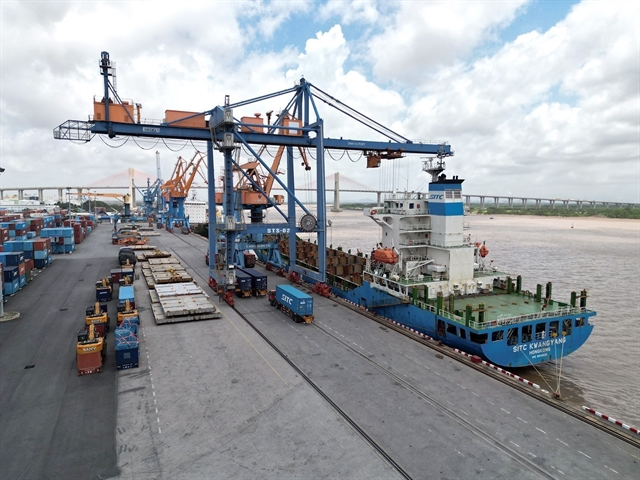
Đình Vũ Port in Hải Phòng, northern Việt Nam’s major customs gateway, illustrates how green logistics can drive regional economic growth. — VNA/VNS Photo
Hải Phòng, northern Việt Nam’s major customs gateway, illustrates how green logistics can drive regional economic growth. The city has sustained customs clearance growth above 10 per cent, positioning it as a crucial hub for future trade routes, including direct connections to northern Europe and the Mediterranean.
Trần Tiến Dũng, deputy chairman of the Vietnam Logistics Services Association and chairman of Hải Phòng Logistics Association, highlights the untapped potential of sea and rail transport in the region.
At present, road transport dominates, accounting for nearly 99 per cent of cargo movement and leading to inefficiencies and higher emissions.
To address this, Macstar Group has launched inland waterway transport routes linking Hải Phòng to Ninh Bình, significantly reducing transit times and expanding cargo capacity via the Nghĩa Hưng Canal, dubbed the 'Panama Canal of Việt Nam'. This waterway offers an open-airspace advantage, allowing larger vessels and more environmentally friendly transport options.
Macstar is also pioneering research into sustainable fuels like solar energy and green hydrogen for its fleet. Still, Dũng notes that Government support is crucial in issuing technical standards and guidelines to enable businesses to adopt these technologies on a larger scale.
Expanding beyond the Hải Phòng-Ninh Bình corridor, Macstar has introduced routes to Nghi Sơn and Vũng Áng, and plans to connect with Quảng Trị Province to facilitate trade with Laos via border gates. These initiatives represent a growing regional network prioritising efficiency and sustainability.
Australia’s green logistics journey also provides valuable insights for Việt Nam. Executive Director of the Australian Chamber of Commerce (AusCham) in Việt Nam Edwin Law explains that in Australia, green logistics is mandatory, not optional. Companies embed sustainability goals into their core strategies, investing in green transportation, renewable energy and environmentally friendly supply chains.
Technology plays a pivotal role. Australian firms use advanced digital platforms and automation to reduce energy consumption and costs while improving service quality. Many of these innovations have been successfully transferred to Việt Nam through partnerships and joint ventures.
Moreover, Vietnamese factories’ recent adoption of energy-saving measures and environmental standards signals a growing commitment to sustainability.
Law emphasised that such progress demonstrates Việt Nam’s dedication to net zero emissions, a goal achievable only through a collaborative ecosystem involving businesses, government and civil society.
Yap Kwong Weng, CEO of Vietnam SuperPort, a joint venture between Singapore’s YCH Group and Vietnam’s T&T Group, advocates for a multimodal, integrated logistics model to accelerate the green transformation.
Vietnam SuperPort combines air cargo terminals, bonded warehouses and cross-border transportation services to optimise efficiency and reduce environmental impacts.
Unlike conventional mass industrial parks, this approach leverages existing assets to create a structural advantage within regional supply chains. For example, where regulations permit, goods can be shipped directly from warehouse to aircraft, cutting transport time and emissions.
Vietnam SuperPort aims to achieve net zero emissions by 2040 through a roadmap that includes deploying renewable energy, automated warehouses, carbon-neutral materials and emissions-free operations. The company is partnering with international organisations like the International Finance Corporation to develop green infrastructure financing models, blending public and private funding sources.
However, Yap stressed that policy support and financial incentives are essential. Encouraging green finance mechanisms and blended finance structures will enable businesses to invest confidently in sustainable logistics solutions. — VNS
Source: VNS
Related News

MEMBER CORNER / PROMOTIONS
AN ELECTRIFYING NIGHT WITH THE "QUEEN OF DANCE" THU MINH AT THE GRAND HO TRAM!
The stage at The Grand Ballroom is set to catch fire as Vietnam’s undisputed "Queen of Dance," Thu Minh, takes the spotlight. Renowned for her powerhouse vocals, magnetic stage presence, and sultry, high-energy performances, Thu Minh promises an evening of pure musical euphoria. The energy escalates with an exclusive appearance by special guest and The Voice champion, Vu Thao My.
HR / LABOUR/ EMPLOYMENT
HIGH-QUALITY HUMAN RESOURCES NEEDED TO ATTRACT NEW TECH INVESTMENT CAPITAL
Besides infrastructure, Việt Nam must also rapidly develop a highly skilled workforce to attract investment in AI, semiconductors and advanced manufacturing, experts have said. Don Lam, CEO and co-founder of investment management company VinaCapital, said that global technology investors were increasingly looking at the readiness of the entire ecosystem, with high-quality human resources a decisive factor.
HR / LABOUR/ EMPLOYMENT
HIRING OUTLOOK STRENGTHENS IN Q4 AS SKILLS SHORTAGES PERSIST
Hiring intentions among employers in Việt Nam strengthened in the fourth quarter, with 52 per cent of surveyed companies planning to increase headcount between October and December, according to a ManpowerGroup survey released this week. Việt Nam's hiring outlook was stronger than the Asia Pacific and Middle East (APME) regional average of 33 per cent and the global average of 29 per cent, ranking third in the region and 11th globally among 42 markets surveyed.

BANKING / FINANCE / INSURANCE / TAX
LARGE BANKS FORECAST TO GAIN HIGHER PROFITABILITY IN H2 2026
The return on average assets (ROAA) of the banking sector will likely remain stable at around 1.5 per cent in the second half of 2026, but profitability divergence among banks will increase, with large banks outperforming peers on stronger margins and diversified earnings, analysts forecast. In a recent report on the banking sector, analysts from the Vietnam Investors Service Rating said the sector’s ROAA rose by 10 basis points quarter-on-quarter to 1.51 per cent in the first half of this year, driven by net interest margin (NIM) improvements at some State-owned banks and large private banks.
GARMENT / TEXTILE
VIỆT NAM'S FOOTWEAR, BAG EXPORTS TO US TOP $8 BILLION IN EIGHT MONTHS
Việt Nam's exports of footwear and handbags to the US exceeded US$8 billion in the first eight months of 2026, as the US and EU remained the country's biggest markets despite sluggish growth in footwear shipments. Exports from Việt Nam's leather and footwear sector reached more than $2.45 billion in August, down 9 per cent from July but up 3 per cent from a year earlier, according to preliminary statistics.
VIETNAM ECONOMY INVESTMENT
LÂM ĐỒNG TARGETS DIGITAL ECONOMY TO ACCOUNT FOR 30 PER CENT OF GRDP BY 2030
Lâm Đồng Province aims to raise the digital economy’s contribution to around 30 per cent of its gross regional domestic product (GRDP) by 2030, as part of a five-year plan to develop digital economy and society issued recently. Under Plan No. 15358/KH-UBND, the province targets more than 60 per cent of small- and medium-sized enterprises (SMEs) to adopt digital technologies by 2030 while increasing the value of cashless payments to 30 times its GRDP.
Events Sponsors






















