Want to be in the loop?
subscribe to
our notification
Business News
FUNDRAISING ON THE UP IN CONSUMER FINANCE
Consumer finance companies are taking different approaches to raise cash and gain a bigger slice of the landscape.
SSI Research has cited information from VPBank’s Board of Management that the due diligence process for FE Credit sale has been conducted. FE Credit, Vietnam’s largest consumer finance firm, is in negotiation with its potential partners, though the discussion progress is somewhat interrupted due to the pandemic.
However, VPBank expects the negotiation to be completed in the second quarter of 2021. If the two sides cannot reach a mutual agreement, VPBank would consider an initial public offering (IPO) for FE Credit by the end of this year.
Based on the two scenarios, SSI’s analysis team gave some assessment on the impact of the sale of FE Credit on VPBank’s consolidated financial statements. If VPBank sells a 49-per-cent-stake in FE Credit at a valuation of around four times compared to the book value, the bank can record an after-tax profit of VND21 trillion ($913 million).
According to Vietnamese accounting standards, if VPBank’s control over FE Credit is maintained by holding 51 per cent of stakes, profit from the above capital sale will not be recognised as revenue. Instead, it will be directly recognised in the retained earnings on the bank’s balance sheet.
With an additional $913 million in capital, VPBank will reduce the dependence on customer deposits, thereby reducing the average cost of capital. After the deal is completed, VPBank’s consolidated pre-tax profit is estimated to increase by VND800 billion ($34.8 million) compared to the scenario where there is no capital sale at FE Credit.
In 2020, FE Credit’s pre-tax profwas estimated to reach VND3.713 trillion ($161.43 million), down 16.3 per cent on-year, according to the latest report by VPBank.
Meanwhile, HD Saison – the consumer finance arm of HDBank and Japan’s Credit Saison – was previously greenlit to switch from a limited liability to a joint-stock company format. The firm is reportedly preparing for an upcoming IPO.
Last December, Credit Saison signalled its intention to expand its investment in Southeast Asia, especially Vietnam and Indonesia, with an initial commitment of around $9.6 million for local lenders. Credit Saison will finance such projects as lending to low-income borrowers and microenterprises in a practice known as impact investing.
Elsewhere, SHB Finance is actively promoting the non-cash payment economy by co-operating with MasterCard. By partnering with SHB Finance, MasterCard wants to provide the most up-to-date digitalised user experiences to customers. Simultaneously, the company would bolster access to modest-income earners. Do Quang Hien, chairman of SHB’s Board, also revealed that the consumer finance company is in the middle of negotiations with a foreign partner.
Hoang The Hung, deputy general director of Electricity Finance JSC, said that the company’s consumer loan disbursement balance in the past year reached VND1 trillion ($23 million), which failed to meet its target. The major reason lies in its strict loan disbursement to facilitate a better risk management mechanism.
Elsewhere, foreign-invested consumer finance companies are laying focus on diversifying disbursement loans approaches. New products introduced over the past year are presenting alternative options for a wider swath of both Vietnamese and foreign customers.
For example, Lotte Finance introduces credit cards in cooperation with other foreign banks such as NHB and KB. The firm also boasts several loans such as for cars and learning English with Jaxtina English Center.
Mirae Asset Finance, on the other hand, decided to follow through on a broad diversification strategy. The South Korean company offers cash and electronics loan for education and beauty purposes. The loan package for beauty purposes would capitalise on clients who want to undergo plastic surgery.
Home Credit, meanwhile, is creating new ways for the consumer finance industry by bolstering its insurance business to help customers alleviate the risks of permanent disability or death.
According to the State Bank of Vietnam (SBV), by the end of 2020, the scale of Vietnam’s consumer finance market came to around VND1.8 quadrillion (over $77.25 billion), accounting for over 20 per cent of outstanding loans in the economy, up 7.4 per cent compared to the end of 2019.
Dao Minh Tu, Deputy Governor of the SBV, emphasised in a conference in last month that promoting consumer finance and simplifying procedures for loan applications would be placed as top priority to abolish black credit.
In recent years, the SBV and credit institutions in localities have been coordinating with the Ministry of Public Security and local authorities in implementing drastic measures to limit black credit. The SBV will continue improving the awareness of locals about credit policies, loan packages, and procedures for loan applications so that people could easily access bank loans.
Meanwhile, the central bank will study and soon complete legal documents to deploy mobile money services in Vietnam while making loans from microfinance institutions easily accessible to citizens and then gradually limit black credit.
Source: VIR
Related News

MEMBER CORNER / PROMOTIONS
AN ELECTRIFYING NIGHT WITH THE "QUEEN OF DANCE" THU MINH AT THE GRAND HO TRAM!
The stage at The Grand Ballroom is set to catch fire as Vietnam’s undisputed "Queen of Dance," Thu Minh, takes the spotlight. Renowned for her powerhouse vocals, magnetic stage presence, and sultry, high-energy performances, Thu Minh promises an evening of pure musical euphoria. The energy escalates with an exclusive appearance by special guest and The Voice champion, Vu Thao My.

HR / LABOUR/ EMPLOYMENT
HIGH-QUALITY HUMAN RESOURCES NEEDED TO ATTRACT NEW TECH INVESTMENT CAPITAL
Besides infrastructure, Việt Nam must also rapidly develop a highly skilled workforce to attract investment in AI, semiconductors and advanced manufacturing, experts have said. Don Lam, CEO and co-founder of investment management company VinaCapital, said that global technology investors were increasingly looking at the readiness of the entire ecosystem, with high-quality human resources a decisive factor.

HR / LABOUR/ EMPLOYMENT
HIRING OUTLOOK STRENGTHENS IN Q4 AS SKILLS SHORTAGES PERSIST
Hiring intentions among employers in Việt Nam strengthened in the fourth quarter, with 52 per cent of surveyed companies planning to increase headcount between October and December, according to a ManpowerGroup survey released this week. Việt Nam's hiring outlook was stronger than the Asia Pacific and Middle East (APME) regional average of 33 per cent and the global average of 29 per cent, ranking third in the region and 11th globally among 42 markets surveyed.

BANKING / FINANCE / INSURANCE / TAX
LARGE BANKS FORECAST TO GAIN HIGHER PROFITABILITY IN H2 2026
The return on average assets (ROAA) of the banking sector will likely remain stable at around 1.5 per cent in the second half of 2026, but profitability divergence among banks will increase, with large banks outperforming peers on stronger margins and diversified earnings, analysts forecast. In a recent report on the banking sector, analysts from the Vietnam Investors Service Rating said the sector’s ROAA rose by 10 basis points quarter-on-quarter to 1.51 per cent in the first half of this year, driven by net interest margin (NIM) improvements at some State-owned banks and large private banks.
GARMENT / TEXTILE
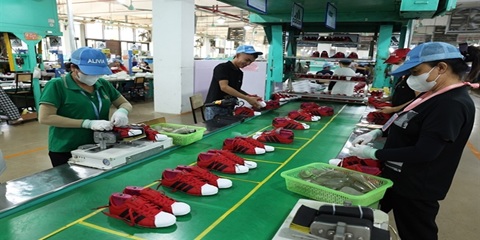
VIỆT NAM'S FOOTWEAR, BAG EXPORTS TO US TOP $8 BILLION IN EIGHT MONTHS
Việt Nam's exports of footwear and handbags to the US exceeded US$8 billion in the first eight months of 2026, as the US and EU remained the country's biggest markets despite sluggish growth in footwear shipments. Exports from Việt Nam's leather and footwear sector reached more than $2.45 billion in August, down 9 per cent from July but up 3 per cent from a year earlier, according to preliminary statistics.

VIETNAM ECONOMY INVESTMENT
LÂM ĐỒNG TARGETS DIGITAL ECONOMY TO ACCOUNT FOR 30 PER CENT OF GRDP BY 2030
Lâm Đồng Province aims to raise the digital economy’s contribution to around 30 per cent of its gross regional domestic product (GRDP) by 2030, as part of a five-year plan to develop digital economy and society issued recently. Under Plan No. 15358/KH-UBND, the province targets more than 60 per cent of small- and medium-sized enterprises (SMEs) to adopt digital technologies by 2030 while increasing the value of cashless payments to 30 times its GRDP.
Events Sponsors






















