Want to be in the loop?
subscribe to
our notification
Business News
FOOTWEAR INDUSTRY ACCELERATES GREEN TRANSITION, STRENGTHENS SUPPLY CHAINS
Lefaso has called for faster development of the domestic supporting industry to reduce reliance on imported materials. It also proposed establishing strategic raw material reserves and trading platforms to improve supply security.
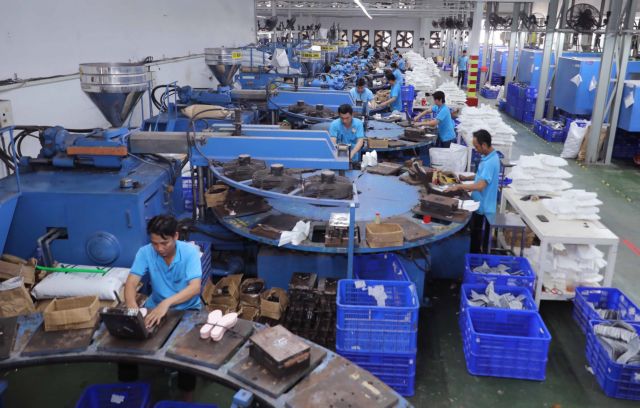
A shoes production line at Viễn Thịnh Shoes Company in Long Hậu Industrial Zone in southern province of Tây Ninh. Việt Nam is currently the world's third-largest footwear producer, after China and India, and the second-largest exporter.— VNA/VNS Photo
HÀ NỘI — Việt Nam's footwear industry is stepping up efforts to build greener production and strengthen domestic supply chains as it seeks to maintain export growth amid global uncertainties.
The sector earned nearly US$12 billion from exports in the first half of 2026. During the period, Việt Nam also overtook China to become the largest footwear supplier to the US market for the first time.
Footwear exports reached $11.95 billion during the first six months of the year, up 0.5 per cent from a year earlier. Although shipments to markets such as China, Japan, the UK and Mexico declined, exports recovered strongly toward the end of the second quarter.
In June alone, overseas shipments rose to $ 2.16 billion, more than $200 million higher than in May, supported by strong demand from the US and the EU, statistics show.
The US remained Việt Nam's largest export market, accounting for nearly 39 per cent of the industry's total export value with shipments worth an estimated $4.55 billion during the year's first half, up more than 6 per cent year-on-year.
Việt Nam is currently the world's third-largest footwear producer, after China and India, and the second-largest exporter. Around 90 per cent of its footwear production is sold overseas.
However, the industry's heavy dependence on exports also makes it vulnerable to external shocks. Experts say geopolitical tensions, rising logistics costs and increasingly strict trade policies in major markets are putting pressure on manufacturers.
Dr Võ Trí Thành, President of the Institute for Brand and Competitiveness Strategy, pointed out that businesses are facing both supply chain disruptions caused by geopolitical conflicts in the Middle East and growing trade protection measures in the US.
Raw materials account for 60–65% of the cost of producing a pair of shoes. Facts in the second quarter showed that companies with sufficient inventories were better able to cope with higher logistics costs to deliver orders on time, while many smaller firms had to reject export orders because they lacked materials.
To strengthen competitiveness, the Vietnam Leather, Footwear and Handbag Association (Lefaso) has called for faster development of the domestic supporting industry to reduce reliance on imported materials. It also proposed establishing strategic raw material reserves and trading platforms to improve supply security.
The industry is also accelerating its green transition to meet stricter sustainability requirements, particularly in the EU, including carbon reduction, product traceability and Digital Product Passport regulations, according to Lefaso Vice Chairwoman and General Secretary Phan Thi Thanh Xuan.
Since the second quarter, many large manufacturers have increased investment in clean technologies, automation, digital transformation and environmentally friendly materials. At the same time, companies are shifting from contract manufacturing to original design and brand development while leveraging the 17 free trade agreements Vietnam has signed to expand into new markets such as India, the Middle East and Africa.
Lefaso said maintaining a skilled workforce also remains essential, adding that stronger supply chain resilience will be key to helping Vietnam preserve its position in the global footwear market. — VNS
Source: VNS
Related News
VIETNAM ECONOMY INVESTMENT
FOREIGN INVESTORS SEEKING A SYNCHRONISED MANUFACTURING ECOSYSTEM
Instead of focusing only on land costs and incentives as usual, foreign investors are seeking a synchronised manufacturing ecosystem, from stable power supply and logistics to shared infrastructure and the convenience of completing residence procedures for experts to serve their long-term investment in the country.
INFRASTRUCTURE / CONSTRUCTION / LOGISTIC / PORT
DONG THAP PROVINCE STEPS UP INDUSTRIAL EXPANSION AND INFRASTRUCTURE CONNECTIVITY
Accelerating public investment, strengthening inter-regional connectivity, and expanding industrial land are helping Dong Thap efficiently bolster competitiveness and drive economic growth. Following the 2025 merger of the former Dong Thap and Tien Giang provinces, the expanded Dong Thap province in the Mekong Delta faces mounting pressure to accelerate infrastructure development and strengthen connectivity among local economic zones, urban areas, industrial parks (IPs), and production centres.
PROPERTY / INDUSTRIAL ZONE
HCM CITY ATTRACTS US$5.7 BILLION INTO EXPORT PROCESSING AND INDUSTRIAL ZONES
HCM City attracted US$5.7 billion in domestic and foreign investment into its export processing and industrial zones during the first nine months of 2026. The figure exceeded the city's full-year target by 31 per cent, highlighting strong momentum in high-quality industrial investment under Resolution No.10-NQ/TW. Total investment reached 131 per cent of the 2026 target of $4.25 billion and represented a 29 per cent increase compared with the same period in 2025, according to the city's Export Processing and Industrial Zones Authority (HEPZA).

BANKING / FINANCE / INSURANCE / TAX
REMITTANCES TO HCM CITY RISE NEARLY 40% IN Q3
Remittances to HCM City reached more than US$2.83 billion in the third quarter of this year, up 39.5 per cent from the previous quarter and 3.6 per cent year-on-year. This was the first quarter showing positive annual growth this year, helping narrow the decline in remittance inflows over the first nine months. According to the State Bank of Vietnam (SBV)’s Regional Branch 2, remittances transferred to HCM City through credit institutions and economic organisations totalled $2.835 billion in Q3, an increase of more than $802 million from the previous quarter.
VIETNAM ECONOMY INVESTMENT
LOCALITIES REPORT BREAKTHROUGH RESULTS IN FDI IN FIRST NINE MONTHS
In Ho Chi Minh City, total registered capital reached $17.2 billion in the first nine months, up 4.2 times from the same period last year. The figure included more than $9.35 billion in newly registered capital and over $4.9 billion in additional capital for existing projects. Foreign investors also registered more than $2.9 billion through capital contributions and share purchases.

TECHNOLOGY
TECH SECTOR GROWTH OPENS UP OPPORTUNITIES FOR VIỆT NAM TO GO GLOBAL
The growth of the electronics, semiconductor and high-tech sectors worldwide is opening up a variety of opportunities for Vietnamese enterprises to integrate more deeply into the global supply chain. However, to become suppliers for these corporations, domestic enterprises must meet rigorous standards regarding quality, technology, productivity and order fulfilment capabilities.
Events Sponsors






















