Want to be in the loop?
subscribe to
our notification
Business News
DOMESTIC CAPITAL RISES, NEW FDI FALLS IN IPS IN HCMC
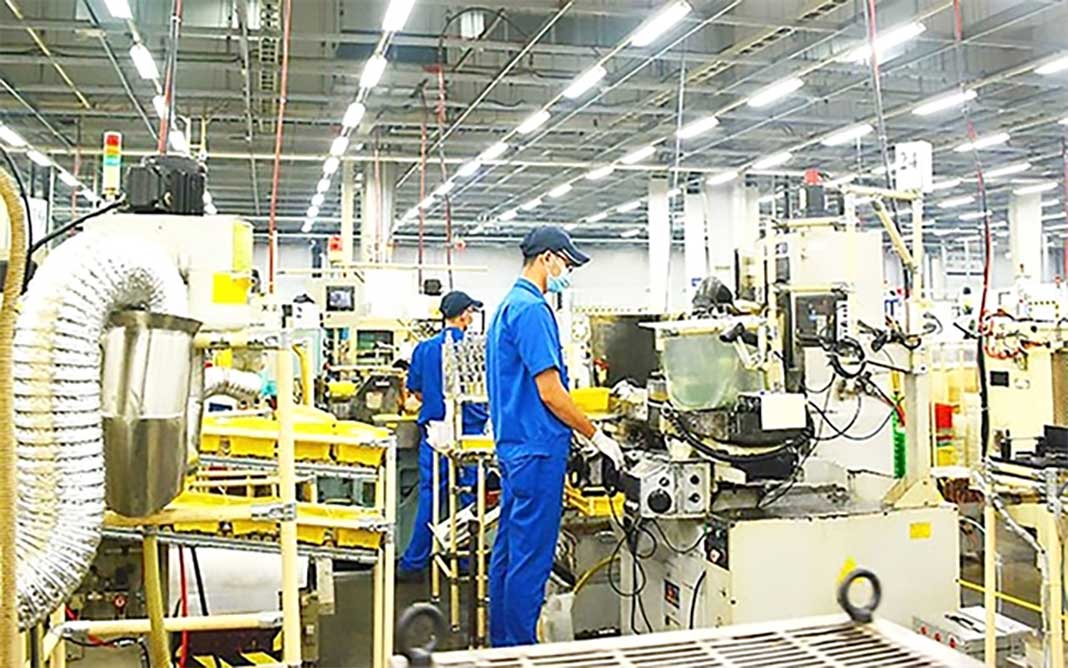
Workers are seen at a factory in HCMC - PHOTO: VNA
HCMC – Capital inflows into export processing zones (EPZs) and industrial parks (IPs) in HCMC in 2025 showed a clear divergence, with domestic investment rising strongly while foreign direct investment (FDI) declining in newly licensed projects.
According to the Ho Chi Minh City Export Processing and Industrial Zones Authority (HEPZA), total investment capital attracted in 2025, including newly approved projects and capital revisions, exceeded US$5.4 billion, up 2.66% year-on-year and surpassing the annual target by 19.46%.
Demand for production space surged alongside this growth: leased land reached 475.13 hectares, up more than 71%, while leased factory space exceeded 620,600 square meters, more than 4.5 times higher than a year earlier.
However, the investment landscape revealed a mismatch between the two capital flows. FDI inflows totaled more than US$3.44 billion, down 5.78% year-on-year. Notably, newly registered FDI fell sharply, with 218 new projects capitalized at over US$1.42 billion, a steep decline of 43.24%.
In contrast, adjusted FDI capital jumped 76.35% to more than US$2 billion across 189 projects, indicating that existing foreign investors continued to expand operations rather than launching many large-scale new projects.
Domestic investment, meanwhile, emerged as a bright spot. Total domestic capital reached VND49 trillion, equivalent to more than US$1.96 billion, up 19.44% year-on-year. Newly registered domestic capital picked up by over 30% to nearly VND34 trillion in 107 projects, reflecting the proactive expansion of local enterprises amid global cost volatility and more cautious international capital flows.
By contrast, adjusted capital from domestic firms edged down 8.61%, suggesting that new investment played the main role in driving growth.
By the end of 2025, HCMC’s EPZs and IPs had 5,341 active investment projects with total registered capital of nearly US$78 billion. Of this, FDI projects accounted for the bulk in terms of capital scale, at US$57.17 billion, while domestic projects totaled about US$20.78 billion. Nearly 90% of projects were in operation, pointing to relatively high system stability, although more than 90 projects remained temporarily suspended.
Under the 2021–2030 master plan, HCMC aims to develop 105 EPZs and IPs covering more than 50,000 hectares. At present, 58 operating industrial parks report an average occupancy rate of around 80%, putting significant pressure on land availability and the restructuring of industrial space in the coming years.
In terms of labor, nearly 915,000 workers are employed in the city’s EPZs and IPs, with more than 77% working for FDI firms. This underscores that despite a slowdown in newly licensed FDI, the foreign-invested sector remains a pillar for job creation and production.
Source: The Saigon Times
Related News

BANKING / FINANCE / INSURANCE / TAX
REMITTANCES TO HCM CITY RISE NEARLY 40% IN Q3
Remittances to HCM City reached more than US$2.83 billion in the third quarter of this year, up 39.5 per cent from the previous quarter and 3.6 per cent year-on-year. This was the first quarter showing positive annual growth this year, helping narrow the decline in remittance inflows over the first nine months. According to the State Bank of Vietnam (SBV)’s Regional Branch 2, remittances transferred to HCM City through credit institutions and economic organisations totalled $2.835 billion in Q3, an increase of more than $802 million from the previous quarter.

TECHNOLOGY
TECH SECTOR GROWTH OPENS UP OPPORTUNITIES FOR VIỆT NAM TO GO GLOBAL
The growth of the electronics, semiconductor and high-tech sectors worldwide is opening up a variety of opportunities for Vietnamese enterprises to integrate more deeply into the global supply chain. However, to become suppliers for these corporations, domestic enterprises must meet rigorous standards regarding quality, technology, productivity and order fulfilment capabilities.

VIETNAM ECONOMY INVESTMENT
FOREIGN INVESTORS SEEKING A SYNCHRONISED MANUFACTURING ECOSYSTEM
Instead of focusing only on land costs and incentives as usual, foreign investors are seeking a synchronised manufacturing ecosystem, from stable power supply and logistics to shared infrastructure and the convenience of completing residence procedures for experts to serve their long-term investment in the country.

MEMBER CORNER / PROMOTIONS
SENTRYSAFE FHW40200 – PROTECT YOUR VALUABLES, ENJOY PEACE OF MIND!
Looking for a reliable solution to protect your important documents, cash, and valuables from fire and water damage? Genuine SENTRYSAFE - Reliable protection for your valuables and peace of mind! Contact Sen Wai Vietnam for more information and personalized product recommendations.

PROPERTY / INDUSTRIAL ZONE
HCM CITY ATTRACTS US$5.7 BILLION INTO EXPORT PROCESSING AND INDUSTRIAL ZONES
HCM City attracted US$5.7 billion in domestic and foreign investment into its export processing and industrial zones during the first nine months of 2026. The figure exceeded the city's full-year target by 31 per cent, highlighting strong momentum in high-quality industrial investment under Resolution No.10-NQ/TW. Total investment reached 131 per cent of the 2026 target of $4.25 billion and represented a 29 per cent increase compared with the same period in 2025, according to the city's Export Processing and Industrial Zones Authority (HEPZA).

INFRASTRUCTURE / CONSTRUCTION / LOGISTIC / PORT
DONG THAP PROVINCE STEPS UP INDUSTRIAL EXPANSION AND INFRASTRUCTURE CONNECTIVITY
Accelerating public investment, strengthening inter-regional connectivity, and expanding industrial land are helping Dong Thap efficiently bolster competitiveness and drive economic growth. Following the 2025 merger of the former Dong Thap and Tien Giang provinces, the expanded Dong Thap province in the Mekong Delta faces mounting pressure to accelerate infrastructure development and strengthen connectivity among local economic zones, urban areas, industrial parks (IPs), and production centres.
Events Sponsors






















