Want to be in the loop?
subscribe to
our notification
Business News
DECREES CLARIFY CONTAINER DEPOT QUESTIONS
Newly-constructed inland container depots (ICD) must have a minimum area of five hectares and be up to environmental protection and fire and explosion prevention standards.
The requirement has been clarified in newly issued Government decree 38/2017/ND-CP on the management of ICDs in Việt Nam.
According to the decree, ICDs are used to wrap and unload goods transported via containers and move them to sea ports and other locations.
ICDs are also used to complete customs procedures on imports and exports, temporarily store goods and repair containers.
The decrees clarifies that ICDs must be formed following ICD development planning that has been approved and attached with primary transport corridors to connect sea ports.
ICDs must have at least two transport methods and have enough land funds for offices and long-term development.
The Government has assigned the Transport Ministrty to establish, publish and update a list of ICDs annually on the portals of the ministry and Marine Department.
The ministry is also in charge of State management of ICDs, directing inter-sector activities and implementing regulations.
According to the decree, Vietnamese and foreign organisations and individuals investing in Vietnamese ICDs must follow decree regulations.
Investments in ICD construction must be in keeping with ICD development planning and related planning, it said.
The decree also requires ICD investors to submit to the ministry’s Marine Department a copy of construction investment decision, its design, design approval decision and the project’s environmental assessment.
Figures from the ministry show that there are 24 ICDs in Việt Nam. There are ten ICDs in the north, which are connected with Hải Phòng. However, most have no connection with other modes of transport such as railways and waterways.
According to Nguyễn Xuân Sang, director of the Ministry of Transport’s Marine Department, in the south, ten ICDs are connected with the sea ports of Vũng Tàu and HCM City, seven of which are linked with domestic waterways.
Many ICDs in the north are not connected with the sea, rivers or railroads. Thus, these ICDs are restricted to supplying road transport services and storage.
In the south, ICDs operate more effectively. Up to 80 per cent of goods nationwide are transported via these depots. However, some ICDs are located inside the city, causing traffic jams. It is necessary to relocate these depots.
Most of the ICDs in the country have poorly constructed warehouses, which results in inefficiency, Sang said.
Decree 38/2017/ND-CP serves as a foundation for the ICD system across the country to develop according to planning.
According to the Government’s ICD planning until 2020 with a vision to 2030, the ICD system is expected to reach the capacity of 6 million TEU (twenty-foot equivalent units, a standard unit for describing a ship’s cargo capacity) each year. By 2030, the figure is hoped to hit 14.2 million TEU.
Source: VIR
Related News

MEMBER CORNER / PROMOTIONS
SENTRYSAFE CHW20201 - EFFECTIVE WATER RESISTANCE, MAXIMUM PROTECTION
In unexpected flooding situations, the most important thing is to keep your valuables dry and intact. SentrySafe CHW20201 is specially designed with superior water-resistant capabilities, helping protect documents, cash, and important belongings even when fully submerged. Proven in real testing: After water submersion, the documents inside remain dry - undamaged.

MEMBER CORNER / PROMOTIONS
AN ELECTRIFYING NIGHT WITH THE "QUEEN OF DANCE" THU MINH AT THE GRAND HO TRAM!
The stage at The Grand Ballroom is set to catch fire as Vietnam’s undisputed "Queen of Dance," Thu Minh, takes the spotlight. Renowned for her powerhouse vocals, magnetic stage presence, and sultry, high-energy performances, Thu Minh promises an evening of pure musical euphoria. The energy escalates with an exclusive appearance by special guest and The Voice champion, Vu Thao My.
HR / LABOUR/ EMPLOYMENT
HIGH-QUALITY HUMAN RESOURCES NEEDED TO ATTRACT NEW TECH INVESTMENT CAPITAL
Besides infrastructure, Việt Nam must also rapidly develop a highly skilled workforce to attract investment in AI, semiconductors and advanced manufacturing, experts have said. Don Lam, CEO and co-founder of investment management company VinaCapital, said that global technology investors were increasingly looking at the readiness of the entire ecosystem, with high-quality human resources a decisive factor.

HR / LABOUR/ EMPLOYMENT
HIRING OUTLOOK STRENGTHENS IN Q4 AS SKILLS SHORTAGES PERSIST
Hiring intentions among employers in Việt Nam strengthened in the fourth quarter, with 52 per cent of surveyed companies planning to increase headcount between October and December, according to a ManpowerGroup survey released this week. Việt Nam's hiring outlook was stronger than the Asia Pacific and Middle East (APME) regional average of 33 per cent and the global average of 29 per cent, ranking third in the region and 11th globally among 42 markets surveyed.

BANKING / FINANCE / INSURANCE / TAX
LARGE BANKS FORECAST TO GAIN HIGHER PROFITABILITY IN H2 2026
The return on average assets (ROAA) of the banking sector will likely remain stable at around 1.5 per cent in the second half of 2026, but profitability divergence among banks will increase, with large banks outperforming peers on stronger margins and diversified earnings, analysts forecast. In a recent report on the banking sector, analysts from the Vietnam Investors Service Rating said the sector’s ROAA rose by 10 basis points quarter-on-quarter to 1.51 per cent in the first half of this year, driven by net interest margin (NIM) improvements at some State-owned banks and large private banks.
GARMENT / TEXTILE
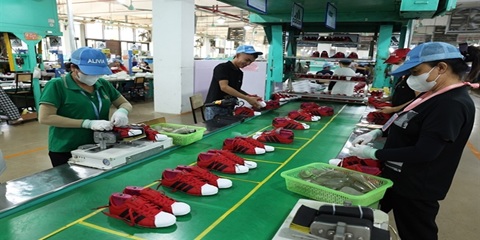
VIỆT NAM'S FOOTWEAR, BAG EXPORTS TO US TOP $8 BILLION IN EIGHT MONTHS
Việt Nam's exports of footwear and handbags to the US exceeded US$8 billion in the first eight months of 2026, as the US and EU remained the country's biggest markets despite sluggish growth in footwear shipments. Exports from Việt Nam's leather and footwear sector reached more than $2.45 billion in August, down 9 per cent from July but up 3 per cent from a year earlier, according to preliminary statistics.
Events Sponsors






















