Want to be in the loop?
subscribe to
our notification
Business News
CREDIT GROWTH SLOWING DOWN, RAISING FEAR OF BUSINESS CONTRACTION
Credit growth in the first months of this year slowed significantly due to high interest rates and firms’ poor health, raising concerns about rising bad debts.
Credit growth by the end of February 2023 increased by nearly 0.8 per cent, equal to only one-third of the rate in the same period last year.
However, the low credit growth is not because of banks’ shortage of capital and credit growth quota like at the end of last year.
The banking system's liquidity is currently in excess with more than VNĐ50 trillion (US$2.1 billion), higher than the SBV’s mandatory requirements. The credit growth quota of banks is also very abundant in the wake of the State Bank of Vietnam (SBV)’s credit growth quota granting early this month.
Governor Nguyễn Thị Hồng attributed the slow credit growth to some reasons.
First, she said, the first two months of the year coincided with the Lunar New Year, so capital demand was low during the long holiday.
Secondly, many firms are still affected by the COVID-19 pandemic, thus they are unable to meet the banks’ lending conditions.
Orders at many firms declined, making the demand for loans to fall from last year.
Finally, the difficulty of the real estate market has also caused the loan demand to decline, the Governor said.
In a report sent to the Government, the Ministry of Planning and Investment said the low credit growth showed difficulties in absorbing the capital of firms and the economy.
According to many firms, their orders decreased, so they almost had no demand for loans. Even instead of borrowing more capital, many firms have tried to pay off existing loans to reduce financial pressure.
Most export firms are facing a decrease in orders. High inflation and declining purchasing power in major markets such as the US and the EU directly hurt firms.
A representative of the Vietnam Textile and Apparel Association said the decrease in global purchasing power would likely cause the number of orders of the whole textile and garment industry to decrease by 25-30 per cent in the first quarter of 2023.
The situation is not brighter for firms in the wood and furniture industry. Đỗ Thị Kim Loan, general director of Sao Nam Trading and Production Company Limited, said orders from her company decreased by 30-35 per cent compared to last year.
Banking expert Cấn Văn Lực told the Việt Nam News that besides decreasing consumer demand, firms are also facing difficulties in accessing capital and high interest rates.
As firms’ health is exhausted, Lực is very concerned about the risk of rising bad debt.
“Currently, the bad debt ratio of the whole banking system is still under control with an on-balance sheet bad debt ratio of 2 per cent," Lực noted. "However, bad debts can worsen under the context of adverse impacts of the unfavourable conditions post-pandemic while the economy is at risk of a slight recession and the foreign exchange rate is under rising pressure.”
Nguyễn Hoài Nam, deputy general secretary of the Vietnam Association of Seafood Exporters and Producers (VASEP), said high interest rates are the biggest concern of firms. Therefore, he suggested the SBV offer a more preferential interest rate policy for seafood exporters, who are under great pressure due to high input costs.
Phạm Thế Anh, head of the National Economics University’s Economics Faculty, said many factors would support interest rate reduction in 2023.
Việt Nam should accept the devaluation of the Vietnamese đồng in the short term to reduce interest rates as high interest rates are more harmful to the economy than the devaluation of the đồng, Anh suggested.
The good news for firms is that commercial banks have agreed to further reduce the interest rates by 0.2-0.5 percentage points for 6-12 month deposits since early this week to pave the way for a reduction in lending interest rates.
Currently, the highest deposit interest rate is 9 per cent per year against more than 10 per cent last year.
Source: VNS
Related News

MEMBER CORNER / PROMOTIONS
AN ELECTRIFYING NIGHT WITH THE "QUEEN OF DANCE" THU MINH AT THE GRAND HO TRAM!
The stage at The Grand Ballroom is set to catch fire as Vietnam’s undisputed "Queen of Dance," Thu Minh, takes the spotlight. Renowned for her powerhouse vocals, magnetic stage presence, and sultry, high-energy performances, Thu Minh promises an evening of pure musical euphoria. The energy escalates with an exclusive appearance by special guest and The Voice champion, Vu Thao My.

HR / LABOUR/ EMPLOYMENT
HIGH-QUALITY HUMAN RESOURCES NEEDED TO ATTRACT NEW TECH INVESTMENT CAPITAL
Besides infrastructure, Việt Nam must also rapidly develop a highly skilled workforce to attract investment in AI, semiconductors and advanced manufacturing, experts have said. Don Lam, CEO and co-founder of investment management company VinaCapital, said that global technology investors were increasingly looking at the readiness of the entire ecosystem, with high-quality human resources a decisive factor.

HR / LABOUR/ EMPLOYMENT
HIRING OUTLOOK STRENGTHENS IN Q4 AS SKILLS SHORTAGES PERSIST
Hiring intentions among employers in Việt Nam strengthened in the fourth quarter, with 52 per cent of surveyed companies planning to increase headcount between October and December, according to a ManpowerGroup survey released this week. Việt Nam's hiring outlook was stronger than the Asia Pacific and Middle East (APME) regional average of 33 per cent and the global average of 29 per cent, ranking third in the region and 11th globally among 42 markets surveyed.

BANKING / FINANCE / INSURANCE / TAX
LARGE BANKS FORECAST TO GAIN HIGHER PROFITABILITY IN H2 2026
The return on average assets (ROAA) of the banking sector will likely remain stable at around 1.5 per cent in the second half of 2026, but profitability divergence among banks will increase, with large banks outperforming peers on stronger margins and diversified earnings, analysts forecast. In a recent report on the banking sector, analysts from the Vietnam Investors Service Rating said the sector’s ROAA rose by 10 basis points quarter-on-quarter to 1.51 per cent in the first half of this year, driven by net interest margin (NIM) improvements at some State-owned banks and large private banks.
GARMENT / TEXTILE
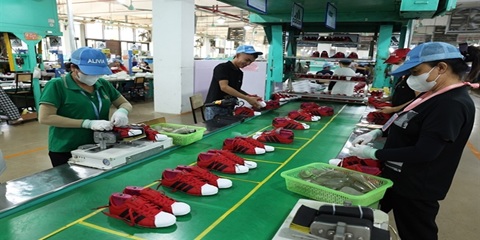
VIỆT NAM'S FOOTWEAR, BAG EXPORTS TO US TOP $8 BILLION IN EIGHT MONTHS
Việt Nam's exports of footwear and handbags to the US exceeded US$8 billion in the first eight months of 2026, as the US and EU remained the country's biggest markets despite sluggish growth in footwear shipments. Exports from Việt Nam's leather and footwear sector reached more than $2.45 billion in August, down 9 per cent from July but up 3 per cent from a year earlier, according to preliminary statistics.

VIETNAM ECONOMY INVESTMENT
LÂM ĐỒNG TARGETS DIGITAL ECONOMY TO ACCOUNT FOR 30 PER CENT OF GRDP BY 2030
Lâm Đồng Province aims to raise the digital economy’s contribution to around 30 per cent of its gross regional domestic product (GRDP) by 2030, as part of a five-year plan to develop digital economy and society issued recently. Under Plan No. 15358/KH-UBND, the province targets more than 60 per cent of small- and medium-sized enterprises (SMEs) to adopt digital technologies by 2030 while increasing the value of cashless payments to 30 times its GRDP.
Events Sponsors






















