Want to be in the loop?
subscribe to
our notification
Business News
CONVERTING DANANG FROM AN INDUSTRIAL TO LOGISTICS CENTRE
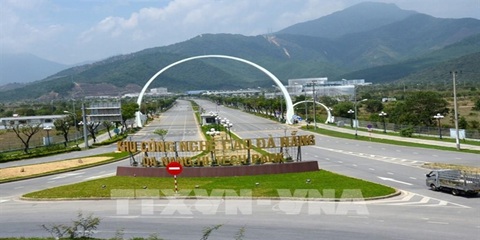
Developing ecological industrial real estate is a new direction for the central city of Danang in its strategy to attract investment into high-tech projects, with many companies interested in large-scale logistics projects manifested by the upcoming Lien Chieu deepwater port.
According to Pham Truong Son, director of Danang High-Tech Park and Industrial Zones Management Authority, the city has so far implemented a plan to construct an eco-industrial model in Hoa Khanh Industrial Park. This plan is contributing to limit the impact of the industrial zones (IZ) on the environment.
The efficiency from cleaner production has been not only breaking the urban chain in the west of the city but also linking urban areas turning the high-tech park into a highlight in the formation system of eco-industrial real estate products, which is attracting many investors in the city.
Currently, the high-tech park bears the character of an urban area inhabited by professionals, scientists, investors, employees, and their families.
Adjacent to the high-tech park is Danang IT Park, invested in by Danang Information Technology Park Development JSC (DITP). The park will be an ideal living and working environment for more than 25,000 employees including professionals, senior engineers, and other workers.
In the next 10 years, Danang IT Park Phase 1 has a scale of 131 hectares and this land will be increased to 341ha in the second phase. The project will become a satellite city in the northwestern region of Danang with about 100,000 residents. In addition to improving infrastructure projects, DITP is investing a sum of VND1.7 trillion ($74 million) to develop an accommodation project serving experts and utilities for Danang IT Park.
According to Nguyen Tam Thinh, chairman of DITP’s Board of Directors, this is a large-scale industrial real estate project to promote investment attraction for Danang IT Park and catch the new investment shift after COVID-19.
Lam Quang Binh, director of Investment and Business Services Company in the city, said that the emergence of extra demand in attracting new-generation capital flows is requiring changes in the existing industrial park model. This means the requirement of an industrial real estate system is enhanced with higher technical standards.
“Among those, within current requirements, it is necessary to focus on planning clean, ecological, environmentally-friendly IZs and industrial clusters, attracting high technologies with sustainable goals and long-term development,” Binh explained.
Planning must be synchronously made and publicly announced for investors to research and take opportunities and jump into investment early, he added.
Developing a logistics centre
Strong prospects are becoming clear but will also quickly pass if Danang authorities are slow compared to other localities making similar moves.
Binh added that the proactiveness of Danang to develop ecological IZs will help improve the economic development of the city and, at the same time, minimise the impact on the environment, improving the efficiency of natural resource usage and reducing waste.
Therefore, the opportunity to own a land fund to approach and develop the industrial real estate segment is huge for both existing and potential investors in the future. Ecological industrial real estate will emerge as the dominant segment in the market in the coming time, experts say.
Danang has nearly 800 companies specialising in the field of transportation and warehousing. In addition, around 60 bank branches are connected to international transactions and 30 domestic and international insurance companies covering almost all fields.
These are considered part of the most favourable conditions for Danang to become a logistics centre by 2050 with a range of new bases and logistics centres such as those established at Lien Chieu Port, Hoa Nhon, New Kim Lien Cargo Terminal, Danang International Airport, and many other small-scale centres and warehouses.
With such an improved infrastructure system, Danang has been meeting the necessary and sufficient conditions for the development of the logistics industry for the entire central region and is attracting interest from overseas groups and corporations.
At the end of August, LOGOS Group, a member of ARA Fund Management and headquartered in Sydney, began working with Danang authorities to establish a joint venture in Vietnam.
Convenient infrastructure
LOGOS Vietnam Logistics Venture is the fourth joint venture of the Australia-based investor LOGOS established in 2020. The group has raised more than $1 billion of investment capital to penetrate the Vietnamese and South Korean markets – accordingly, LOGOS and its partners will build a portfolio of logistics facilities throughout Vietnam.
LOGOS will reserve an initial investment capital of $350 million to develop logistics property in key locations such as Danang, Hanoi, and Ho Chi Minh City.
LOGOS is investing in Danang because the city has a lot of room for investment and development, in which Lien Chieu Port is a strategic investment project to strongly develop the fields of logistics, e-commerce, and food products, the group explained.
LOGOS Vietnam Logistics Venture’s entry into the country’s real estate logistics market is an important step in its development strategy in the region based on customer demand and interesting economic growth forecasts for Vietnam. Currently, the group’s portfolio in the Asia-Pacific region has 100 logistics properties in nine countries, with total assets under management of about $ 9.5 billion.
According to a representative from LOGOS, the convenient transportation infrastructure will help Danang become a major seaport service centre for the whole region. Danang is developing its urban area in a sustainable way, restructuring the economy towards service development. These are favourable factors for Danang to develop the logistics sector and open a new direction for investors, according to the group.
The adjusted master plan in Danang towards 2030 with a vision until 2045, carried out by a joint venture of Sakae Corporate Advisory Ltd. and Surbana Jurong (Singapore), has determined that Danang will develop a seaport and aviation system associated with logistics services towards forming a supply chain of logistics services in the central region – where the logistics heart is the seaport system of Tien Sa and Lien Chieu, as well as Danang International Airport.
According to Nguyen Thanh Tien, director of Danang Urban Department, the plan has breakthrough proposals such as building a compressed urban model, airport urban area, seaport urban area, and forming new functional areas such as an innovation and renewables zone, a high-tech agricultural zone, and a logistics service centre.
Ho Ky Minh, Deputy Chairman of Danang People’s Committee, said that in order to build such a logistics centre, Danang has to mobilise and call for investment capital from both society and the domestic and international business communities.
Source: VIR
Related News

MEMBER CORNER / PROMOTIONS
AN ELECTRIFYING NIGHT WITH THE "QUEEN OF DANCE" THU MINH AT THE GRAND HO TRAM!
The stage at The Grand Ballroom is set to catch fire as Vietnam’s undisputed "Queen of Dance," Thu Minh, takes the spotlight. Renowned for her powerhouse vocals, magnetic stage presence, and sultry, high-energy performances, Thu Minh promises an evening of pure musical euphoria. The energy escalates with an exclusive appearance by special guest and The Voice champion, Vu Thao My.
HR / LABOUR/ EMPLOYMENT
HIGH-QUALITY HUMAN RESOURCES NEEDED TO ATTRACT NEW TECH INVESTMENT CAPITAL
Besides infrastructure, Việt Nam must also rapidly develop a highly skilled workforce to attract investment in AI, semiconductors and advanced manufacturing, experts have said. Don Lam, CEO and co-founder of investment management company VinaCapital, said that global technology investors were increasingly looking at the readiness of the entire ecosystem, with high-quality human resources a decisive factor.

HR / LABOUR/ EMPLOYMENT
HIRING OUTLOOK STRENGTHENS IN Q4 AS SKILLS SHORTAGES PERSIST
Hiring intentions among employers in Việt Nam strengthened in the fourth quarter, with 52 per cent of surveyed companies planning to increase headcount between October and December, according to a ManpowerGroup survey released this week. Việt Nam's hiring outlook was stronger than the Asia Pacific and Middle East (APME) regional average of 33 per cent and the global average of 29 per cent, ranking third in the region and 11th globally among 42 markets surveyed.

BANKING / FINANCE / INSURANCE / TAX
LARGE BANKS FORECAST TO GAIN HIGHER PROFITABILITY IN H2 2026
The return on average assets (ROAA) of the banking sector will likely remain stable at around 1.5 per cent in the second half of 2026, but profitability divergence among banks will increase, with large banks outperforming peers on stronger margins and diversified earnings, analysts forecast. In a recent report on the banking sector, analysts from the Vietnam Investors Service Rating said the sector’s ROAA rose by 10 basis points quarter-on-quarter to 1.51 per cent in the first half of this year, driven by net interest margin (NIM) improvements at some State-owned banks and large private banks.
GARMENT / TEXTILE
VIỆT NAM'S FOOTWEAR, BAG EXPORTS TO US TOP $8 BILLION IN EIGHT MONTHS
Việt Nam's exports of footwear and handbags to the US exceeded US$8 billion in the first eight months of 2026, as the US and EU remained the country's biggest markets despite sluggish growth in footwear shipments. Exports from Việt Nam's leather and footwear sector reached more than $2.45 billion in August, down 9 per cent from July but up 3 per cent from a year earlier, according to preliminary statistics.
VIETNAM ECONOMY INVESTMENT
LÂM ĐỒNG TARGETS DIGITAL ECONOMY TO ACCOUNT FOR 30 PER CENT OF GRDP BY 2030
Lâm Đồng Province aims to raise the digital economy’s contribution to around 30 per cent of its gross regional domestic product (GRDP) by 2030, as part of a five-year plan to develop digital economy and society issued recently. Under Plan No. 15358/KH-UBND, the province targets more than 60 per cent of small- and medium-sized enterprises (SMEs) to adopt digital technologies by 2030 while increasing the value of cashless payments to 30 times its GRDP.
Events Sponsors






















