Want to be in the loop?
subscribe to
our notification
Business News
CONSUMER FINANCE IN MAJOR TIE-UP TENDENCY
The pandemic-triggered turbulence continues to gnaw at the consumer finance industry in Vietnam, but some players are exploring potential new approaches to the challenges, particularly from some international investors.
FE Credit – the largest consumer finance company in Vietnam, accounting for more than 50 per cent of market share – has reported declining profit since last year.
In the first half of 2021, the company’s pre-tax profit was only $52.2 million, equivalent to nearly 50 per cent of the same period last year. FE Credit only contributes 12 per cent to VPBank’s consolidated profits, while this ratio before the pandemic was between 40-50 per cent.
Securities group VNDIRECT believes the pandemic has taken a toll on the consumer finance industry. FE Credit’s non-performing loans (NPL) spiked 9.1 per cent at end of H1, from 7.7 per cent at the end of the first quarter and 6.2 per cent at end of 2020. However, the mega deal of $1.4 billion for 49 per cent stake in FE Credit between VPBank and Japanese lender SMFG would create more business synergies for VPBank to leverage other banking services.
“VPBank is in the process of finalising the paperwork to recognise this profit, which is expected in the second half of 2021,” VNDIRECT confirmed to VIR. “FE Credit will focus mainly on familiar customers, and try to expand to other potential customers such as doctors and teachers. In addition, SMFG will help FE credit to increase its influence in the Vietnamese market.”
Meanwhile, HDSaison – the consumer finance arm of HDBank and Japan’s Credit Saison – recorded a 5.5 per cent increase in its pre-tax profit in H1/2021. The lender’s cost-to-total income ratio continues to improve strongly, currently only 46.7 per cent, lower than last year’s figures. Its NPL ratio at the end of June remained the same as at the beginning of the year.
Currently, FE Credit is the company with the largest market share, followed by Home Credit, HD Saison, and MCredit. Home Credit is the only wholly foreign-owned entity.
While FE Credit and HD Saison are experiencing a dwindling path in the last two years, MCredit, a company under the ownership of MB and Shinsei Bank of Japan, has witnessed a remarkable expansion. It reported pre-tax profits of $15.04 million for the first half of the year, up 188 per cent over the same period last year.
MCredit targets low-, middle-income, and underbanked customers, without collateral. Despite its late arrival, MCredit entered the top four consumer finance companies in Vietnam, although its charter capital was only the tenth-highest.
Brokerage ACB Securities (ACBS) cautioned that the rapid growth can also trigger bad debt risks to MCredit. In 2021, ACBS expects bad debt to decrease due to the firm’s stricter policy since last year, and because it no longer focuses on aggressive market growth as in the previous periods.
Elsewhere, privately-held lender SHB last week revealed it is working with 2-3 partners to sell capital at SHB Finance – the bank’s consumer finance subsidiary, with the deal almost completed.
Besides this, SHB is also selling its shares in two overseas subsidiaries, SHB Laos and SHB Cambodia. SHB wants to partner up with foreign investors to diversify its sources and enhance its operation to be in line with international standards.
“SHB, as the parent company, will selectively choose the healthiest partners, those with a strong financial background,” said Do Quang Hien, chairman of SHB.
Meanwhile, Nguyen Hoang Linh, MSB CEO, said that the bank is negotiating to divest all stakes in its consumer finance arm FCCOM, with the final arrangement slated to be completed in 2022.
MSB’s initial plan was to find a foreign investor to receive 50 per cent of the bank’s ownership in FCCOM. However, the bank now plans to divest all stakes in the consumer finance company.
In April, South Korean credit card company Huyndai Card failed to acquire a 50-per-cent stake in FCCOM in a deal that would have been worth roughly $42 million.
Meanwhile, other fintech players also picked up on the consumer finance industry. E-wallet player MoMo is striving to expand its suite of services, which will help to branch out into areas like motorcycle insurance and consumer loans. In addition, it has acquired a software company that aims to speed up product development, Nikkei Asia reported.
Tuong Nguyen, executive vice chairman and co-CEO at MoMo, emphasised that the diverse portfolio of services has helped to drive revenues to the firm.
Key development trends
Besides enabling consumer finance companies to reshape their businesses to adapt to the new normal, the unprecedented COVID-19 outbreaks have accelerated key trends in the industry.
- The pandemic has prompted the acceleration of the digital transformation for customer experiences among consumer finance companies;
- The launch of mobile money and the booming of digital payments has brought both challenges and opportunities for companies, especially their credit card businesses; and
- Mergers and acquisitions are game-changers fostering future growth in the consumer finance market. The government’s policies support sector consolidation and expansion of consumer finance companies to repel black credit market.
Source: VIR
Related News

MEMBER CORNER / PROMOTIONS
AN ELECTRIFYING NIGHT WITH THE "QUEEN OF DANCE" THU MINH AT THE GRAND HO TRAM!
The stage at The Grand Ballroom is set to catch fire as Vietnam’s undisputed "Queen of Dance," Thu Minh, takes the spotlight. Renowned for her powerhouse vocals, magnetic stage presence, and sultry, high-energy performances, Thu Minh promises an evening of pure musical euphoria. The energy escalates with an exclusive appearance by special guest and The Voice champion, Vu Thao My.

HR / LABOUR/ EMPLOYMENT
HIGH-QUALITY HUMAN RESOURCES NEEDED TO ATTRACT NEW TECH INVESTMENT CAPITAL
Besides infrastructure, Việt Nam must also rapidly develop a highly skilled workforce to attract investment in AI, semiconductors and advanced manufacturing, experts have said. Don Lam, CEO and co-founder of investment management company VinaCapital, said that global technology investors were increasingly looking at the readiness of the entire ecosystem, with high-quality human resources a decisive factor.

HR / LABOUR/ EMPLOYMENT
HIRING OUTLOOK STRENGTHENS IN Q4 AS SKILLS SHORTAGES PERSIST
Hiring intentions among employers in Việt Nam strengthened in the fourth quarter, with 52 per cent of surveyed companies planning to increase headcount between October and December, according to a ManpowerGroup survey released this week. Việt Nam's hiring outlook was stronger than the Asia Pacific and Middle East (APME) regional average of 33 per cent and the global average of 29 per cent, ranking third in the region and 11th globally among 42 markets surveyed.

BANKING / FINANCE / INSURANCE / TAX
LARGE BANKS FORECAST TO GAIN HIGHER PROFITABILITY IN H2 2026
The return on average assets (ROAA) of the banking sector will likely remain stable at around 1.5 per cent in the second half of 2026, but profitability divergence among banks will increase, with large banks outperforming peers on stronger margins and diversified earnings, analysts forecast. In a recent report on the banking sector, analysts from the Vietnam Investors Service Rating said the sector’s ROAA rose by 10 basis points quarter-on-quarter to 1.51 per cent in the first half of this year, driven by net interest margin (NIM) improvements at some State-owned banks and large private banks.
GARMENT / TEXTILE
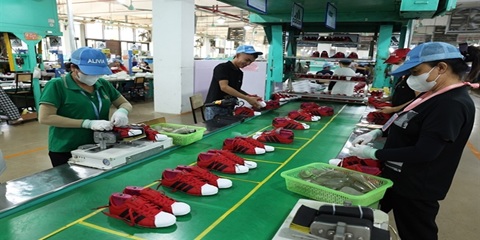
VIỆT NAM'S FOOTWEAR, BAG EXPORTS TO US TOP $8 BILLION IN EIGHT MONTHS
Việt Nam's exports of footwear and handbags to the US exceeded US$8 billion in the first eight months of 2026, as the US and EU remained the country's biggest markets despite sluggish growth in footwear shipments. Exports from Việt Nam's leather and footwear sector reached more than $2.45 billion in August, down 9 per cent from July but up 3 per cent from a year earlier, according to preliminary statistics.

VIETNAM ECONOMY INVESTMENT
LÂM ĐỒNG TARGETS DIGITAL ECONOMY TO ACCOUNT FOR 30 PER CENT OF GRDP BY 2030
Lâm Đồng Province aims to raise the digital economy’s contribution to around 30 per cent of its gross regional domestic product (GRDP) by 2030, as part of a five-year plan to develop digital economy and society issued recently. Under Plan No. 15358/KH-UBND, the province targets more than 60 per cent of small- and medium-sized enterprises (SMEs) to adopt digital technologies by 2030 while increasing the value of cashless payments to 30 times its GRDP.
Events Sponsors






















