Want to be in the loop?
subscribe to
our notification
Business News
CONSTRUCTION OF NORTH-SOUTH HIGH-SPEED RAILWAY TO START IN 2026: PM
Regarding the North-South high-speed railway, Prime Minister Chinh reiterated that under Resolution No. 106/NQ-CP, the Government has approved the overall implementation plan, ensuring construction starts no later than December 2026
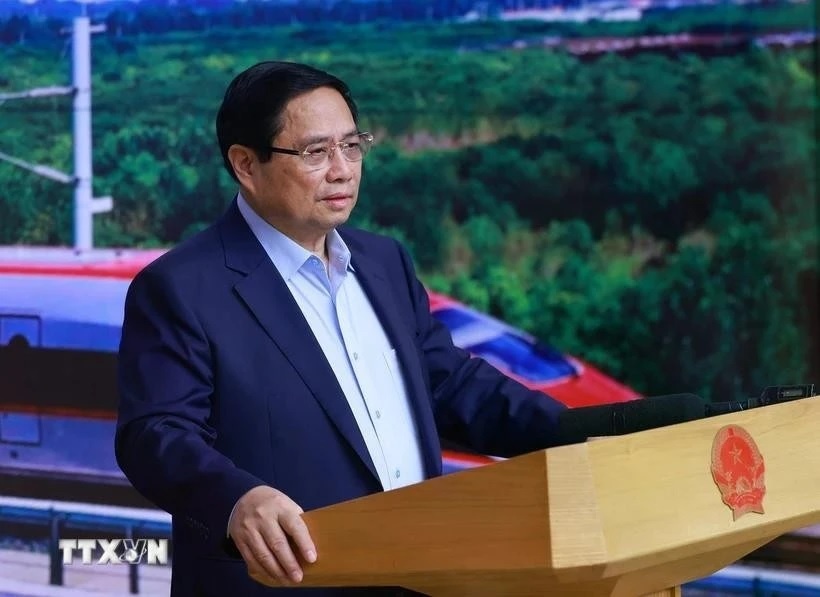
Prime Minister Pham Minh Chinh speaks at the meeting on April 26. (Photo: VNA)
Hanoi - Prime Minister Pham Minh Chinh has emphasised the need for bold and accelerated action to develop the railway industry, serving Vietnam’s long-term national development goals.
Currently, four major railway projects are underway, including the Lao Cai–Hanoi–Hai Phong line, the Hanoi–Lang Son and Hai Phong–Mong Cai lines, the North–South high-speed railway, and urban rail projects in Hanoi and Ho Chi Minh City.
At the first meeting of the Steering Committee for key national railway projects in 2025 held last month, the PM, who also serves as head of the Committee, assigned ministries, sectors, and localities the task of addressing obstacles and accelerating investment preparation procedures for the projects, with 19 scheduled tasks and five regular tasks.
According to ministries, sectors, and localities, all the 24 tasks are currently being actively implemented. Of the 19 scheduled tasks, 12 are not yet due, six have been completed, and one behind schedule.
Speaking at the second meeting of the Steering Committee on April 26, Prime Minister Pham Minh Chinh urged ministries, sectors, and localities to be more proactive and vigorous in adhering to the Party’s orientations, the State’s policies and laws, as well as the resolutions, conclusions, and directives of the Central Party Committee, the Politburo, the National Assembly, the Government, and the Prime Minister in implementing railway projects and developing the railway industry to serve the country’s two centenary goals.
Reaffirming that the objectives remain unchanged, the PM stressed that construction of the Lao Cai – Hanoi – Hai Phong railway must begin in 2025 and the North-South high-speed railway in 2026. He called for the maximum mobilisation and diversification of capital sources, including state and local budgets, loans, bond issuance, and public-private partnerships (PPP) or other forms such as BOT and BT to finance the projects.
Chinh tasked the Ministry of Construction (MoC) and the Ministry of Justice (MoJ) with urgently finalising a Resolution on unified special mechanisms for all railway projects, submitting it to the Government in April, and subsequently to the National Assembly ahead of its ninth session in early May. Concurrently, ministries and agencies are to swiftly develop and submit four related decrees to establish a legal framework for synchronised project implementation.
Regarding the development of the railway industry, PM Chinh stressed the need for technology transfer plans, investment capital mobilisation, human resources development, and smart management systems. He assigned the MoC to lead the drafting of a Prime Ministerial Decision on the catalog of industrial goods and services for the railway sector, to be completed by mid-June. The Ministry of Industry and Trade (MoIT) will lead the drafting of a development project for the railway industry, while the Ministry of Education and Training (MoET) will be responsible for a project on human resources development, both to be completed by the second quarter of 2025.
He also instructed the MoC, in coordination with the Ministry of Foreign Affairs (MoFA) and the Ministry of Finance (MoF), to expedite negotiations with China to finalise a loan agreement, ensuring the project's timeline is met.
For the Lao Cai – Hanoi – Hai Phong railway project, he emphasised the need to design the straightest possible route, bridging rivers, building embankments across fields, and tunneling through mountains where necessary. The MoC was directed to urgently complete the alignment plan as a basis for implementation, while localities must complete land clearance by this September. Relevant agencies are to continue working with China to expedite loan negotiations.
Regarding the North-South high-speed railway, Chinh reiterated that under Resolution No. 106/NQ-CP, the Government has approved the overall implementation plan, ensuring construction starts no later than December 2026. He requested that ministries and localities build detailed plans based on the master schedule and assigned tasks.
For urban railway projects in Hanoi and Ho Chi Minh City, he directed the two cities to strictly follow NA Resolution 188/2015/QH15 and their respective special mechanisms and policies. Any difficulties encountered should be reported for further guidance from relevant ministries and agencies.
The PM stressed the need to mobilise capable state-owned and private enterprises to participate in the projects and in the development of the railway industry. The Viettel Group and VNPT Group were assigned to proactively research, develop, and master technologies related to information systems, signaling, and control systems for railway projects.
Meanwhile, the Vietnam Railways Corporation was tasked with coordinating with the Hanoi People’s Committee to expedite procedures related to the Railway Industry Complex serving railway projects, and to report to higher authorities for decision-making. The PM also suggested considering assigning major tasks to capable private corporations, provided transparency, integrity, and efficiency are ensured.
Source: VIR
Related News

MEMBER CORNER / PROMOTIONS
AN ELECTRIFYING NIGHT WITH THE "QUEEN OF DANCE" THU MINH AT THE GRAND HO TRAM!
The stage at The Grand Ballroom is set to catch fire as Vietnam’s undisputed "Queen of Dance," Thu Minh, takes the spotlight. Renowned for her powerhouse vocals, magnetic stage presence, and sultry, high-energy performances, Thu Minh promises an evening of pure musical euphoria. The energy escalates with an exclusive appearance by special guest and The Voice champion, Vu Thao My.
HR / LABOUR/ EMPLOYMENT
HIGH-QUALITY HUMAN RESOURCES NEEDED TO ATTRACT NEW TECH INVESTMENT CAPITAL
Besides infrastructure, Việt Nam must also rapidly develop a highly skilled workforce to attract investment in AI, semiconductors and advanced manufacturing, experts have said. Don Lam, CEO and co-founder of investment management company VinaCapital, said that global technology investors were increasingly looking at the readiness of the entire ecosystem, with high-quality human resources a decisive factor.

HR / LABOUR/ EMPLOYMENT
HIRING OUTLOOK STRENGTHENS IN Q4 AS SKILLS SHORTAGES PERSIST
Hiring intentions among employers in Việt Nam strengthened in the fourth quarter, with 52 per cent of surveyed companies planning to increase headcount between October and December, according to a ManpowerGroup survey released this week. Việt Nam's hiring outlook was stronger than the Asia Pacific and Middle East (APME) regional average of 33 per cent and the global average of 29 per cent, ranking third in the region and 11th globally among 42 markets surveyed.

BANKING / FINANCE / INSURANCE / TAX
LARGE BANKS FORECAST TO GAIN HIGHER PROFITABILITY IN H2 2026
The return on average assets (ROAA) of the banking sector will likely remain stable at around 1.5 per cent in the second half of 2026, but profitability divergence among banks will increase, with large banks outperforming peers on stronger margins and diversified earnings, analysts forecast. In a recent report on the banking sector, analysts from the Vietnam Investors Service Rating said the sector’s ROAA rose by 10 basis points quarter-on-quarter to 1.51 per cent in the first half of this year, driven by net interest margin (NIM) improvements at some State-owned banks and large private banks.
GARMENT / TEXTILE
VIỆT NAM'S FOOTWEAR, BAG EXPORTS TO US TOP $8 BILLION IN EIGHT MONTHS
Việt Nam's exports of footwear and handbags to the US exceeded US$8 billion in the first eight months of 2026, as the US and EU remained the country's biggest markets despite sluggish growth in footwear shipments. Exports from Việt Nam's leather and footwear sector reached more than $2.45 billion in August, down 9 per cent from July but up 3 per cent from a year earlier, according to preliminary statistics.
VIETNAM ECONOMY INVESTMENT
LÂM ĐỒNG TARGETS DIGITAL ECONOMY TO ACCOUNT FOR 30 PER CENT OF GRDP BY 2030
Lâm Đồng Province aims to raise the digital economy’s contribution to around 30 per cent of its gross regional domestic product (GRDP) by 2030, as part of a five-year plan to develop digital economy and society issued recently. Under Plan No. 15358/KH-UBND, the province targets more than 60 per cent of small- and medium-sized enterprises (SMEs) to adopt digital technologies by 2030 while increasing the value of cashless payments to 30 times its GRDP.
Events Sponsors






















