Want to be in the loop?
subscribe to
our notification
Business News
CITY TO COMPLETE MAJOR TRANSPORT PROJECTS AT GATEWAYS BY 2025
HCM City plans to complete a number of major transport projects by 2025 that are expected to reduce traffic congestion at city gateways and improve connections to neighbouring provinces.
At the city’s northwest gateway, the second branch of the An Sương tunnel at the An Sương intersection in District 12 has recently opened to traffic, easing traffic congestion.
The 385-metre branch is exclusively used for automobiles traveling from Củ Chi District to the city centre, according to the HCM City Management Board for Traffic Works Construction and Investment.
The work at An Sương intersection had been suspended since the end of 2018 because of delayed site clearance. Hóc Môn District was not able to hand over land to the investor of the project until October last year.
Lương Minh Phúc, head of the management board, said the An Sương intersection of National Highway 22 and National Highway 1A has for years faced heavy traffic with many container trucks, posing a risk of accidents.
When the entire project is put in use, the three-layer interchange will help reduce congestion and ensure traffic safety.
Construction on the double tunnel at An Sương intersection began in early 2017.
The first branch, which extends from downtown to outlying Củ Chi District, opened in March 2018 after nearly 13 months of construction.
The double tunnel project, with total capital of VNĐ514 billion ($22.14 million), was originally expected to be completed within 20 months.
The total length of the two tunnels is about 850m. Each two-lane tunnel is 9m wide and 125m long, with a ceiling height of 4.75m.
In addition, work began a few months ago on a VNĐ830 billion ($35.6 million) project to transform the Nguyễn Văn Linh-Nguyễn Hữu Thọ intersection in District 7,
This is expected to help tackle traffic gridlock at the city’s southern gateway.
The first phase of the project, which is slated to be completed in June 2022, will see the construction of two 480-metre-long tunnels on Nguyễn Văn Linh, running beneath the intersection.
The tunnels will allow vehicles to head toward the Tân Thuận Export Processing Zone or National Highway 1A without having to cross Nguyễn Hữu Thọ Street, as is currently the case.
The tunnels will be 14m wide and allow speeds of up to 60 kilometres per hour.
Under the second phase of the project, two overpasses will be built at the intersection.
This phase will cost some VNĐ1.78 trillion since a large amount of ground will need to be cleared to make way for the work.
In addition, a series of works such as the expansion of Lương Định Của and Đỗ Xuân Hợp streets, and Thăng Long and Công Lý bridges, will be built from 2021 to 2022, according to the Management Board for Traffic Works Construction and Investment.
The management board has urged district authorities to hand over the land to complete the expansion of Đồng Văn Cống Street in District 2, as well as construction of Mỹ Thủy 3 Bridge, tunnels and overpasses near the new Miền Đồng (Eastern) Bus Station in District 9.
Many key projects such as Ring Road No 2, Cát Lái Bridge, Thủ Thiêm Bridge Nos 2, 3 and 4, and expansion of Nguyễn Duy Trinh Street and the An Phú intersection will also be completed from 2023 to 2025, connecting District 2, District 9 and Thủ Đức District with the city centre and neighbouring provinces.
In addition, construction will begin in the second quarter next year on major projects to reduce congestion near Tân Sơn Nhất airport and Cát Lái Port area, and projects to expand the city’s gateways such as National Highway 50 and National Highway 22.
As part of a plan to develop the new Thủ Đức City in the eastern part of HCM City, a series of key transport projects will also be built to meet the new city’s socio-economic development.
Engineer Vũ Thắng, former deputy head of the HCM City Planning and Investment Department of Transport Infrastructure, said: “Priority will be given to belt road, highway, and urban railway projects. When projects are completed, traffic congestion will be eased and city development will be strengthened.”
Lương Minh Phúc, director of the city’s Management Board for Traffic Works Construction and Investment, said the city is expected to complete 29 traffic projects this year, including 81km of new roads and 18 bridges.
Source: VNS
Related News

MEMBER CORNER / PROMOTIONS
AN ELECTRIFYING NIGHT WITH THE "QUEEN OF DANCE" THU MINH AT THE GRAND HO TRAM!
The stage at The Grand Ballroom is set to catch fire as Vietnam’s undisputed "Queen of Dance," Thu Minh, takes the spotlight. Renowned for her powerhouse vocals, magnetic stage presence, and sultry, high-energy performances, Thu Minh promises an evening of pure musical euphoria. The energy escalates with an exclusive appearance by special guest and The Voice champion, Vu Thao My.
HR / LABOUR/ EMPLOYMENT
HIGH-QUALITY HUMAN RESOURCES NEEDED TO ATTRACT NEW TECH INVESTMENT CAPITAL
Besides infrastructure, Việt Nam must also rapidly develop a highly skilled workforce to attract investment in AI, semiconductors and advanced manufacturing, experts have said. Don Lam, CEO and co-founder of investment management company VinaCapital, said that global technology investors were increasingly looking at the readiness of the entire ecosystem, with high-quality human resources a decisive factor.

HR / LABOUR/ EMPLOYMENT
HIRING OUTLOOK STRENGTHENS IN Q4 AS SKILLS SHORTAGES PERSIST
Hiring intentions among employers in Việt Nam strengthened in the fourth quarter, with 52 per cent of surveyed companies planning to increase headcount between October and December, according to a ManpowerGroup survey released this week. Việt Nam's hiring outlook was stronger than the Asia Pacific and Middle East (APME) regional average of 33 per cent and the global average of 29 per cent, ranking third in the region and 11th globally among 42 markets surveyed.
BANKING / FINANCE / INSURANCE / TAX
LARGE BANKS FORECAST TO GAIN HIGHER PROFITABILITY IN H2 2026
The return on average assets (ROAA) of the banking sector will likely remain stable at around 1.5 per cent in the second half of 2026, but profitability divergence among banks will increase, with large banks outperforming peers on stronger margins and diversified earnings, analysts forecast. In a recent report on the banking sector, analysts from the Vietnam Investors Service Rating said the sector’s ROAA rose by 10 basis points quarter-on-quarter to 1.51 per cent in the first half of this year, driven by net interest margin (NIM) improvements at some State-owned banks and large private banks.
GARMENT / TEXTILE
VIỆT NAM'S FOOTWEAR, BAG EXPORTS TO US TOP $8 BILLION IN EIGHT MONTHS
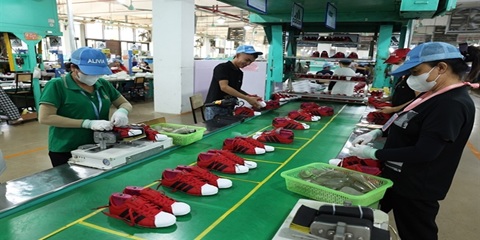
Việt Nam's exports of footwear and handbags to the US exceeded US$8 billion in the first eight months of 2026, as the US and EU remained the country's biggest markets despite sluggish growth in footwear shipments. Exports from Việt Nam's leather and footwear sector reached more than $2.45 billion in August, down 9 per cent from July but up 3 per cent from a year earlier, according to preliminary statistics.
VIETNAM ECONOMY INVESTMENT
LÂM ĐỒNG TARGETS DIGITAL ECONOMY TO ACCOUNT FOR 30 PER CENT OF GRDP BY 2030
Lâm Đồng Province aims to raise the digital economy’s contribution to around 30 per cent of its gross regional domestic product (GRDP) by 2030, as part of a five-year plan to develop digital economy and society issued recently. Under Plan No. 15358/KH-UBND, the province targets more than 60 per cent of small- and medium-sized enterprises (SMEs) to adopt digital technologies by 2030 while increasing the value of cashless payments to 30 times its GRDP.
Events Sponsors






















