Want to be in the loop?
subscribe to
our notification
Business News
CAN THO EYES TRANSFORMATION INTO A MODERN INTERNATIONAL LOGISTICS HUB
Leveraging strategic infrastructure and ambitious investment plans, Can Tho city is positioning itself as a modern international logistics hub serving the Greater Mekong subregion.
The merger of Can Tho city with Soc Trang and Hau Giang provinces has elevated Can Tho’s status to a centrally administered tier-1 megacity, serving as the core urban centre and growth engine of the delta region.
With its extensively expanded economic space, Can Tho now possesses a range of strategic advantages, including an extensive road transport network with both north-south and east-west expressways; an inland waterway transport system; an international airport; a network of ports along the Hau River; a large concentration of industrial parks and agricultural and seafood processing facilities; and connectivity to the Mekong development corridor.
These advantages provide better conditions for Can Tho to develop into the region’s logistics hub, serving as an effective link between production, processing, trade and exports.
The city has identified logistics as a high value-added, knowledge-intensive economic sector that plays a decisive role in enhancing the competitiveness of the delta region’s commodities. Such development is considered one of the city’s strategic priorities, with the goal of transforming Can Tho into the cargo transshipment centre and supply chain coordination centre of the Mekong Delta region.
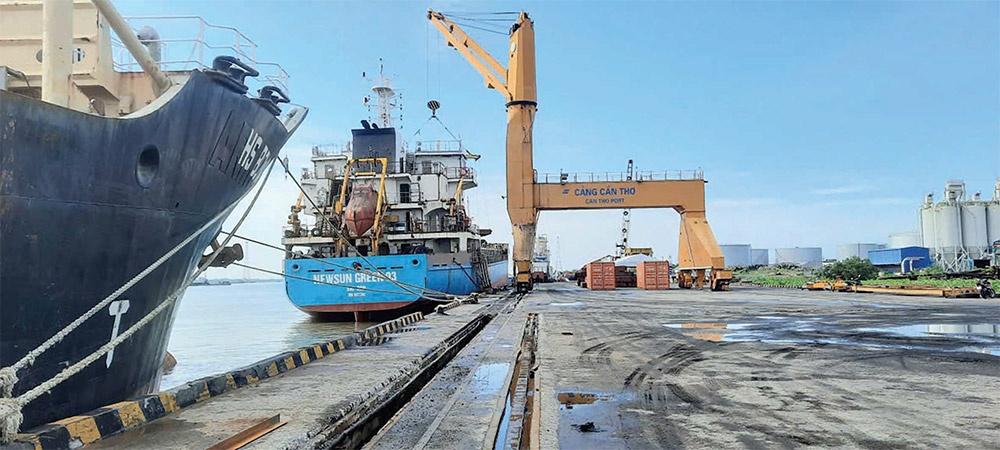
A vessel docks at Cai Cui Port in Can Tho city
Funding for logistics
According to Can Tho Department of Industry and Trade, the city is currently home to more than 500 enterprises involved in logistics-related activities.
In addition, four centres are already in operation: the Hau Giang maritime services and seaport area, Mekong port and logistics centre, Hau Giang agricultural export centre, and Number One Co., Ltd.’s logistics centre, all located in Chau Thanh commune.
Two additional centres are under construction: Mekong distribution warehouse complex in Chau Thanh commune, and Hau Giang cold store centre in Thanh Xuan commune.
The total cargo throughput handled by Can Tho ports reached approximately 12-15 million tonnes per year in 2025. This figure is expected to double once the new centres become operational.
According to Hua Truong Son, deputy director of Can Tho Department of Industry and Trade, the city’s logistics development strategy aims for the sector’s value-added contribution to account for more than 12 per cent of regional GDP.
The strategy also targets an outsourcing rate for logistics services of over 80 per cent; 70 per cent of sector employees receiving professional and technical training, including 30 per cent holding university degrees or higher; at least 80 per cent of logistics service providers adopting digital transformation solutions; and reaching an average annual growth of more than 16 per cent for the city’s logistics services industry.
To achieve these goals, alongside efforts to attract investment in logistics infrastructure, the city plans to establish a network of core centres through investment promotion initiatives.
These projects include a grade-2 centre linked to Cai Cui Port; a centre associated with Can Tho International Airport; a service port at the Thot Not area; centres in Dai Thanh ward, Hoa Luu commune, and Tan Hoa commune; and both Soc Trang and Tran De logistics centres.
According to Bui Ba Nghiem, a senior specialist at the Agency of Foreign Trade under the Ministry of Industry and Trade, research findings indicate that Can Tho city possesses all the necessary conditions to develop into a modern international logistics service centre for the Mekong delta and the Greater Mekong subregion under an international hub model.
“However, to realise this ambition, the city must shift from a logistics development approach focused on standalone infrastructure to one centred on an integrated ecosystem, where infrastructure, data, services, businesses, human resources and coordination mechanisms are developed in a synchronised manner,” Nghiem said.
The research also highlights that Can Tho’s distinctive competitive advantage does not lie in becoming merely a cargo transshipment hub, but rather in its potential to serve as the supply chain coordination centre for the Mekong delta’s agricultural, seafood and trade sectors.
The city, therefore, should prioritise the development of digital, green, and cold chain logistics services linked to the region’s key industries.
In the long term, Nghiem proposed that Can Tho position itself as a smart, green model and a strategic gateway to the Greater Mekong subregion.
“This will provide the foundation for expanding the city’s development trajectory from its current role as a regional logistics hub to that of a modern international service centre, thereby enhancing the competitiveness of the delta region and promoting deeper integration into the global economy,” said Nghiem.
An integrated system
According to Le Cong Ly, Standing Vice Chairman of Can Tho People’s Committee, in the coming period, the city shall continue reviewing and updating logistics planning.
“The guiding principle is to avoid fragmented planning characterised by isolated warehouses and storage facilities. Instead, the city aims to establish an integrated network of centres linked to Cai Cui, Thot Not, Can Tho International Airport, industrial parks, agricultural and seafood production zones, the Tran De area, and the broader marine economic space,” he said.
The city will focus on developing multimodal logistics, ensuring efficient connectivity among expressways, inland waterways, seaports, air transport and, in the future, railways.
Particular attention will be given to carefully assessing the role of Tran De Port, the Hau River shipping channel, Cai Cui Port, Can Tho International Airport, and a network of satellite logistics centres in order to reduce dependence on transshipment services outside the region.
He also noted that Can Tho will prioritise the development of agricultural, seafood, and cold-chain logistics. The city is calling for investment in cold storage systems, inspection and certification centres, irradiation facilities, packaging and traceability services, trading platforms and on-site export services.
“The objective is to ensure that the region’s agricultural and seafood products can be preserved, processed, inspected, packaged and exported efficiently within the Mekong delta itself,” Ly added.
In addition, the city will focus on developing logistics enterprises and attracting strategic investors. Can Tho plans to establish a list of priority projects and introduce mechanisms facilitating access to land, infrastructure, green finance, workforce training and streamlined investment procedures.
On that basis, the city will invite major logistics companies, shipping lines, air cargo carriers, cold storage operators, e-commerce firms, and agricultural export businesses to participate in building the Can Tho ecosystem.
Source: VIR
Related News

MEMBER CORNER / PROMOTIONS
AN ELECTRIFYING NIGHT WITH THE "QUEEN OF DANCE" THU MINH AT THE GRAND HO TRAM!
The stage at The Grand Ballroom is set to catch fire as Vietnam’s undisputed "Queen of Dance," Thu Minh, takes the spotlight. Renowned for her powerhouse vocals, magnetic stage presence, and sultry, high-energy performances, Thu Minh promises an evening of pure musical euphoria. The energy escalates with an exclusive appearance by special guest and The Voice champion, Vu Thao My.
HR / LABOUR/ EMPLOYMENT
HIGH-QUALITY HUMAN RESOURCES NEEDED TO ATTRACT NEW TECH INVESTMENT CAPITAL
Besides infrastructure, Việt Nam must also rapidly develop a highly skilled workforce to attract investment in AI, semiconductors and advanced manufacturing, experts have said. Don Lam, CEO and co-founder of investment management company VinaCapital, said that global technology investors were increasingly looking at the readiness of the entire ecosystem, with high-quality human resources a decisive factor.

HR / LABOUR/ EMPLOYMENT
HIRING OUTLOOK STRENGTHENS IN Q4 AS SKILLS SHORTAGES PERSIST
Hiring intentions among employers in Việt Nam strengthened in the fourth quarter, with 52 per cent of surveyed companies planning to increase headcount between October and December, according to a ManpowerGroup survey released this week. Việt Nam's hiring outlook was stronger than the Asia Pacific and Middle East (APME) regional average of 33 per cent and the global average of 29 per cent, ranking third in the region and 11th globally among 42 markets surveyed.
BANKING / FINANCE / INSURANCE / TAX
LARGE BANKS FORECAST TO GAIN HIGHER PROFITABILITY IN H2 2026
The return on average assets (ROAA) of the banking sector will likely remain stable at around 1.5 per cent in the second half of 2026, but profitability divergence among banks will increase, with large banks outperforming peers on stronger margins and diversified earnings, analysts forecast. In a recent report on the banking sector, analysts from the Vietnam Investors Service Rating said the sector’s ROAA rose by 10 basis points quarter-on-quarter to 1.51 per cent in the first half of this year, driven by net interest margin (NIM) improvements at some State-owned banks and large private banks.
GARMENT / TEXTILE
VIỆT NAM'S FOOTWEAR, BAG EXPORTS TO US TOP $8 BILLION IN EIGHT MONTHS
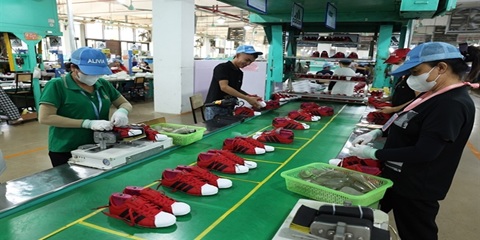
Việt Nam's exports of footwear and handbags to the US exceeded US$8 billion in the first eight months of 2026, as the US and EU remained the country's biggest markets despite sluggish growth in footwear shipments. Exports from Việt Nam's leather and footwear sector reached more than $2.45 billion in August, down 9 per cent from July but up 3 per cent from a year earlier, according to preliminary statistics.
VIETNAM ECONOMY INVESTMENT
LÂM ĐỒNG TARGETS DIGITAL ECONOMY TO ACCOUNT FOR 30 PER CENT OF GRDP BY 2030
Lâm Đồng Province aims to raise the digital economy’s contribution to around 30 per cent of its gross regional domestic product (GRDP) by 2030, as part of a five-year plan to develop digital economy and society issued recently. Under Plan No. 15358/KH-UBND, the province targets more than 60 per cent of small- and medium-sized enterprises (SMEs) to adopt digital technologies by 2030 while increasing the value of cashless payments to 30 times its GRDP.
Events Sponsors






















