Want to be in the loop?
subscribe to
our notification
Business News
BANKS LEND STRONG SUPPORT TO BUSINESS COMMUNITY
The most important funding channel for the Vietnamese economy today is still bank credit. The growth of this channel is currently the highest among funding channels in the market, bringing nearly VND1,400 trillion to the economy. The current support and difficulty sharing by commercial banks not only shows the loyal bank-business relationship, but also helps many banks build more trust, promote their brand names and affirm their responsibility to sustainable development and cooperation with customers.
Pressures on banks' interest rate levels
Dr. Nguyen Quoc Hung, General Secretary of the Vietnam Bankers Association (VNBA), said, in the past two months, with flexible and timely monetary policy management solutions adopted by the State Bank of Vietnam (SBV), the foreign currency market and forex market were less stressed and the liquidity of the banking system picked up. However, deposit interest rates on the primary market remain very high, ranging from 9% to 10% per annum for maturity terms of over 12 months, in which some banks have interest rates up to 11.5% per annum. The continuous rise in interest rates caused fierce competition for deposits and fueled instability for both depositors and borrowers.
Small and medium banks were forced to raise deposit interest rates higher than the market average to retain customers, while unsecured transactions on the interbank market were limited and almost all transactions were required to have collaterals and imposed a higher risk-hedging ratio than before. In addition, credit institutions were under pressure to comply with regulations on the ratio of short-term capital sources used for medium and long-term loans which were slashed from 37% to 34% in October 2022 and expectedly to 30% in October 2023. Thus, commercial banks had to push interest rates for medium and long-term loans higher to comply with regulations.
Rate hikes have raised input costs of all commercial banks to date, much higher than in the first nine months of 2022, while lending rates hardly increased in proportion to deposit rates. That has affected policy enforcement to support businesses to reduce lending rates as directed by the Government and the State Bank of Vietnam and heightened risks of growing bad debts.
Removing obstacles and funding the economy
Before market developments, Prime Minister Pham Minh Chinh signed Official Dispatch 1156/CD-TTg dated December 12, 2022 on removing obstacles and providing credit capital in a timely and proper manner to meet objectives and requirements of the Government and satisfy needs of businesses and people to help promote high growth, rapid recovery, sustainable socioeconomic development and safe, sound and sustainable banking activities. He requested the SBV Governor to consider and speed up implementation of interest rate support program, sourced from the State Budget to fund enterprises, cooperatives and business households; proactively propose solutions to improve program performance; focus credit for priority areas and economic growth drivers (consumption, investment, export, industrial park, social housing and worker housing); improve credit quality and ensure the safety of credit institutions, and national financial and monetary security.
The SBV decided to expand credit room by 1.5-2% on December 5 to provide credit institutions with more resources and increase credit for businesses and essential sectors for the economy. This expansion is equivalent to VND240 trillion added to the economy. By early December, credit growth was 12.2%, 1.8% higher than the preset target of 14%. Plus nearly 2% added, there is 3.8% more credit for the rest of the year, even extended to the upcoming Lunar New Year.
According to Mr. Dao Minh Tu, Standing Deputy Governor of the SBV, the added credit room can be considered one of policies to encourage commercial banks to focus on mobilizing capital and reducing interest rates to facilitate companies, projects and programs to access loans with softer interest rates.
In addition, the Prime Minister directed to remove difficulties for the real estate market. He asked the SBV to direct credit institutions to consider prioritizing loans for social housing projects to really serve people's living needs. So far, the SBV has always regarded this as one of areas of interest and directed commercial banks to facilitate social housing purchases. Therefore, it is necessary to manage cash flows and monitor operations of commercial banks.
Notably, before decisions of the Government and the SBV, commercial banks have now agreed to lower interest rates to support businesses. According to Dr. Nguyen Quoc Hung, as of December 15, 2022, as many as 16 banks pledged to slash interests by 0.5-3% for VND3,500 billion of loans. Accordingly, credit institutions agreed to cap the deposit interest rate of 9.5% per annum, inclusive of all promotions and bonuses.
Speeding up 2% interest support package
According to experts, slashing lending rates by banks, either much or little, is also a valuable support for enterprises in the current context, showing lenders’ efforts to balance their expenses and business targets to provide more loans for enterprises.
Dr. Dinh Trong Thinh, an economic expert, said that it is very hard to keep lending rates stable, as they are now. As deposit interest rates have tended to look up in the last two months, meaning that banks’ input costs have gone up as a result. Therefore, the reduction of lending rates shows that commercial banks are making great efforts to share with businesses, especially during the year-end peak production season and ahead of new-year business planning.
According to experts, to supply soft loans for manufacturers and traders in the coming time, it is necessary to speedily launch the 2% interest rate support package according to Decree 31 of the Government. If this support package is quickly disbursed, it will help ease pressures on capital costs, provide businesses with more access to more resources for year-end production and new year business plans.
Deputy Governor Dao Minh Tu said that the SBV has asked commercial banks to consider cutting interest rates to support businesses and the economy as a responsibility. “Banks reduce interest rates but they cannot increase fees; disburse funds for prioritized areas such as agriculture, rural development, export, manufacturing and driving sectors of the economy,” he noted.
Strictly complying with rate cut commitments is also one of the important factors for the SBV to give credit room to banks in 2023 besides other factors. The SBV will provide the best policy support for banks while ensuring monetary objectives and other objectives assigned by the Government and the National Assembly.
Source: VCCI
Related News

MEMBER CORNER / PROMOTIONS
AN ELECTRIFYING NIGHT WITH THE "QUEEN OF DANCE" THU MINH AT THE GRAND HO TRAM!
The stage at The Grand Ballroom is set to catch fire as Vietnam’s undisputed "Queen of Dance," Thu Minh, takes the spotlight. Renowned for her powerhouse vocals, magnetic stage presence, and sultry, high-energy performances, Thu Minh promises an evening of pure musical euphoria. The energy escalates with an exclusive appearance by special guest and The Voice champion, Vu Thao My.

HR / LABOUR/ EMPLOYMENT
HIGH-QUALITY HUMAN RESOURCES NEEDED TO ATTRACT NEW TECH INVESTMENT CAPITAL
Besides infrastructure, Việt Nam must also rapidly develop a highly skilled workforce to attract investment in AI, semiconductors and advanced manufacturing, experts have said. Don Lam, CEO and co-founder of investment management company VinaCapital, said that global technology investors were increasingly looking at the readiness of the entire ecosystem, with high-quality human resources a decisive factor.

HR / LABOUR/ EMPLOYMENT
HIRING OUTLOOK STRENGTHENS IN Q4 AS SKILLS SHORTAGES PERSIST
Hiring intentions among employers in Việt Nam strengthened in the fourth quarter, with 52 per cent of surveyed companies planning to increase headcount between October and December, according to a ManpowerGroup survey released this week. Việt Nam's hiring outlook was stronger than the Asia Pacific and Middle East (APME) regional average of 33 per cent and the global average of 29 per cent, ranking third in the region and 11th globally among 42 markets surveyed.

BANKING / FINANCE / INSURANCE / TAX
LARGE BANKS FORECAST TO GAIN HIGHER PROFITABILITY IN H2 2026
The return on average assets (ROAA) of the banking sector will likely remain stable at around 1.5 per cent in the second half of 2026, but profitability divergence among banks will increase, with large banks outperforming peers on stronger margins and diversified earnings, analysts forecast. In a recent report on the banking sector, analysts from the Vietnam Investors Service Rating said the sector’s ROAA rose by 10 basis points quarter-on-quarter to 1.51 per cent in the first half of this year, driven by net interest margin (NIM) improvements at some State-owned banks and large private banks.
GARMENT / TEXTILE
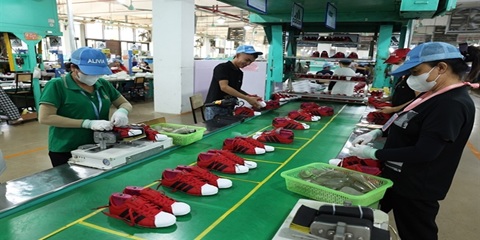
VIỆT NAM'S FOOTWEAR, BAG EXPORTS TO US TOP $8 BILLION IN EIGHT MONTHS
Việt Nam's exports of footwear and handbags to the US exceeded US$8 billion in the first eight months of 2026, as the US and EU remained the country's biggest markets despite sluggish growth in footwear shipments. Exports from Việt Nam's leather and footwear sector reached more than $2.45 billion in August, down 9 per cent from July but up 3 per cent from a year earlier, according to preliminary statistics.

VIETNAM ECONOMY INVESTMENT
LÂM ĐỒNG TARGETS DIGITAL ECONOMY TO ACCOUNT FOR 30 PER CENT OF GRDP BY 2030
Lâm Đồng Province aims to raise the digital economy’s contribution to around 30 per cent of its gross regional domestic product (GRDP) by 2030, as part of a five-year plan to develop digital economy and society issued recently. Under Plan No. 15358/KH-UBND, the province targets more than 60 per cent of small- and medium-sized enterprises (SMEs) to adopt digital technologies by 2030 while increasing the value of cashless payments to 30 times its GRDP.
Events Sponsors






















