Want to be in the loop?
subscribe to
our notification
Business News
BANKING SECTOR STEPS UP ACTION PLAN TO BOOST GREEN CREDIT
SBV’s Deputy Governor Đào Minh Tú said: “Green growth is no longer an option, but has become an urgent necessity, especially for developing countries like Việt Nam."
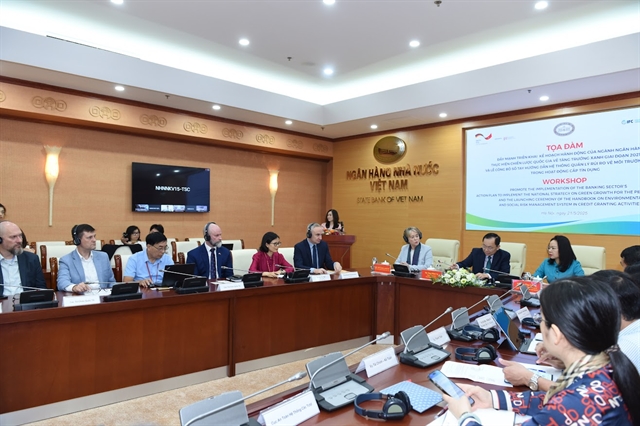
View of the workshop. Photo SBV
HÀ NỘI — Green credit will be promoted through the Việt Nam’s Banking Sector Action Plan to implement the national strategy on green growth for the 2021-2030 period, experts said at a workshop yesterday.
At the workshop, on promoting the implementation of the plan organised by the State Bank of Vietnam (SBV), the GIZ Vietnam and the International Finance Corporation (IFC) in Hà Nội, the SBV’s Deputy Governor Đào Minh Tú said: “Green growth is no longer an option, but has become an urgent necessity, especially for developing countries like Việt Nam.
"The transition to a green growth model - one that combines economic development with environmental protection and efficient use of resources - is not only an inevitable trend but also the most direct path for Việt Nam to achieve a sustainable and prosperous future.”
At the event, the Country Director of GIZ Vietnam, Dr Michaela Baur, emphasised: “Today’s event holds special significance, coinciding with the 50th anniversary of Việt Nam-Germany diplomatic relations in 2025. This year also marks a pivotal review of Việt Nam’s five-year national strategy for green growth.
"On behalf of the German government, GIZ remains committed to working closely with the SBV and other partners to build a more prosperous, greener and more inclusive Việt Nam. The robust green financial system we are building together is a critical foundation for realising this shared vision.”
Talking about the current green criteria classification system for promoting green credit and green growth in Việt Nam, Baur said: “Green taxonomy is essential for guiding financial flows toward green growth and helping Việt Nam access international green finance.
"Since 2017, GIZ has supported the SBV in introducing the first version of a green taxonomy for the banking sector, to help monitor green credit and promote green lending practices.”
According to Baur, as Việt Nam moves into the second phase of its green strategy, a national green taxonomy is crucial. The country should apply across the entire financial system - both banks and capital markets, align with Việt Nam’s industrial classification system, provide a legal basis for green finance incentives, and be in line with international standards
“GIZ has worked with the SBV and other partners to develop this national taxonomy, which is expected to be approved by the Prime Minister in 2025. The green taxonomy will be a key tool to scale up green finance and help Việt Nam meet its green growth and net-zero goals,” she said.
Drawing on German and international best practices, the event served as a platform to advance green finance and support Việt Nam’s transition to a low-carbon, inclusive and sustainable economy.
At the event, representatives from SBV, financial institutions and development partners, reaffirmed their commitment to advancing green and sustainable finance in the banking sector, contributing to a greener, more inclusive and resilient Việt Nam.
The event also witnessed the launch of the Environmental and Social Risk Management System (ESMS) Handbook in Credit Granting Activities, developed by SBV in partnership with IFC.
Based on international standards, it provides credit institutions with practical guidance for building and operating effective risk management systems aligned with environmental, social, and governance (ESG) principles - an essential step toward sustainable finance in Việt Nam.
Since 2023, Việt Nam has made significant strides in green credit, with outstanding loans totalling VNĐ621 trillion (roughly US$24 billion), accounting for 4.64 per cent of the national loan portfolio.
The green transition is capital-intensive, with an estimated funding requirement of $368 billion from 2022 to 2040. Given the public sector can only meet around one-third of this need, mobilising private investment and international cooperation is essential. — BIZHUB/VNS
Source: VNS
Related News

VIETNAM ECONOMY INVESTMENT
FOREIGN INVESTORS SEEKING A SYNCHRONISED MANUFACTURING ECOSYSTEM
Instead of focusing only on land costs and incentives as usual, foreign investors are seeking a synchronised manufacturing ecosystem, from stable power supply and logistics to shared infrastructure and the convenience of completing residence procedures for experts to serve their long-term investment in the country.

INFRASTRUCTURE / CONSTRUCTION / LOGISTIC / PORT
DONG THAP PROVINCE STEPS UP INDUSTRIAL EXPANSION AND INFRASTRUCTURE CONNECTIVITY
Accelerating public investment, strengthening inter-regional connectivity, and expanding industrial land are helping Dong Thap efficiently bolster competitiveness and drive economic growth. Following the 2025 merger of the former Dong Thap and Tien Giang provinces, the expanded Dong Thap province in the Mekong Delta faces mounting pressure to accelerate infrastructure development and strengthen connectivity among local economic zones, urban areas, industrial parks (IPs), and production centres.

PROPERTY / INDUSTRIAL ZONE
HCM CITY ATTRACTS US$5.7 BILLION INTO EXPORT PROCESSING AND INDUSTRIAL ZONES
HCM City attracted US$5.7 billion in domestic and foreign investment into its export processing and industrial zones during the first nine months of 2026. The figure exceeded the city's full-year target by 31 per cent, highlighting strong momentum in high-quality industrial investment under Resolution No.10-NQ/TW. Total investment reached 131 per cent of the 2026 target of $4.25 billion and represented a 29 per cent increase compared with the same period in 2025, according to the city's Export Processing and Industrial Zones Authority (HEPZA).

BANKING / FINANCE / INSURANCE / TAX
REMITTANCES TO HCM CITY RISE NEARLY 40% IN Q3
Remittances to HCM City reached more than US$2.83 billion in the third quarter of this year, up 39.5 per cent from the previous quarter and 3.6 per cent year-on-year. This was the first quarter showing positive annual growth this year, helping narrow the decline in remittance inflows over the first nine months. According to the State Bank of Vietnam (SBV)’s Regional Branch 2, remittances transferred to HCM City through credit institutions and economic organisations totalled $2.835 billion in Q3, an increase of more than $802 million from the previous quarter.

VIETNAM ECONOMY INVESTMENT
LOCALITIES REPORT BREAKTHROUGH RESULTS IN FDI IN FIRST NINE MONTHS
In Ho Chi Minh City, total registered capital reached $17.2 billion in the first nine months, up 4.2 times from the same period last year. The figure included more than $9.35 billion in newly registered capital and over $4.9 billion in additional capital for existing projects. Foreign investors also registered more than $2.9 billion through capital contributions and share purchases.

TECHNOLOGY
TECH SECTOR GROWTH OPENS UP OPPORTUNITIES FOR VIỆT NAM TO GO GLOBAL
The growth of the electronics, semiconductor and high-tech sectors worldwide is opening up a variety of opportunities for Vietnamese enterprises to integrate more deeply into the global supply chain. However, to become suppliers for these corporations, domestic enterprises must meet rigorous standards regarding quality, technology, productivity and order fulfilment capabilities.
Events Sponsors






















