Want to be in the loop?
subscribe to
our notification
Business News
BANK DEPOSITS OVERTAKE CREDIT GROWTH IN LATE AUGUST
Vietnamese đồng deposits at banks grew faster than credit by late August, reversing a trend seen earlier this year and easing some short-term liquidity pressure, although banks continue to face high funding costs amid strong demand for loans.

A transaction at a private bank in HCM City. — VNS Photo Bồ Xuân Hiệp
HCM CITY — Vietnamese đồng deposits at banks grew faster than credit by late August, reversing a trend seen earlier this year and easing some short-term liquidity pressure, although banks continue to face high funding costs amid strong demand for loans.
Speaking at the Government’s regular meeting, Trần Quốc Phương, deputy minister of finance, said that as of August 22, Vietnamese đồng deposits at credit institutions had increased 8.77 per cent from the beginning of the year, slightly exceeding the 8.38 per cent growth in Vietnamese đồng lending.
The development marked a reversal from late June, when deposits had risen by just over 5 per cent, compared with 7.4 per cent growth in credit, according to State Bank of Vietnam data.
However, the improvement was less pronounced when foreign-currency deposits were excluded.
Total outstanding credit stood at around VNĐ20.4 quadrillion as of August 22, more than 9 per cent higher than at the end of 2025, while total deposits exceeded VNĐ19 quadrillion, up 7.97 per cent.
The difference reflects a decline in foreign-currency deposits, meaning total deposits have yet to catch up with total credit despite the stronger growth in Vietnamese đồng deposits.
Banks have continued to step up efforts to attract funding through conventional deposits, certificates of deposit (CD) and bonds as credit demand remains strong.
Deposit interest rates at a number of banks have risen above 9 per cent a year, with some lenders offering rates of around 10 per cent for certain maturities and deposit conditions.
The elevated rates reflect continued competition among banks for stable funding and have kept their cost of capital under pressure.
At a recent banking conference, Phạm Như Ánh, chief executive officer of Military Commercial Joint Stock Bank (MB), said banking-system liquidity toward the end of the year would depend partly on the pace of public-investment disbursement.
Faster disbursement would help support cash flows and liquidity in the banking system, while delays could prolong pressure on monetary policy and banks’ funding needs, he said.
He forecast lending rates would remain broadly stable through the end of the year, with the central bank’s monetary-policy stance likely to be a more important factor than any temporary improvement in banking-system liquidity.
The latest deposit data suggest that funding conditions have improved from the second quarter, but banks are still operating in an environment of strong credit growth and intense competition for deposits.
The narrowing gap between deposit and credit growth could therefore help reduce pressure for further increases in deposit rates, while the overall funding situation remains closely tied to credit demand and the flow of money into the banking system. — VNS
Source: VNS
Related News

MEMBER CORNER / PROMOTIONS
COSMOPARK – ENERGY ADVANTAGES FOR POWER-INTENSIVE INDUSTRIES
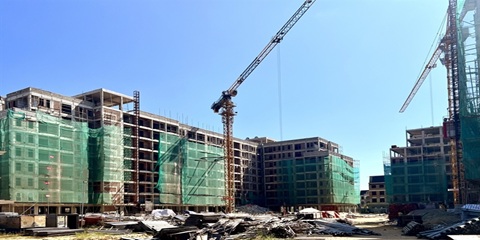
As global corporations place increasing emphasis on energy security, renewable energy adoption, and carbon emissions reduction, electricity is no longer viewed merely as a component of technical infrastructure. For high-tech projects, data centers, and large-scale manufacturing facilities, reliable energy infrastructure has become a critical factor in investment location decisions.
VIETNAM ECONOMY INVESTMENT
FIRMS EXPECT STRONGER Q4 ACTIVITY DESPITE COST, FINANCING PRESSURES
More than VNĐ5 quadrillion is registered to be poured into the economy in the first nine months of this year, up 6.1 per cent. Enterprises are expecting stronger business and production in the last quarter of this year, with new orders, output and labour demand set to improve, although high input costs and cash-flow constraints remain major concerns, according to a survey by the National Statistics Office (NSO) released late last week.

VIETNAM ECONOMY INVESTMENT
LOW-ALTITUDE ECONOMY COULD GROW TO $500 MILLION BY 2035
Việt Nam's low-altitude economy is at an early stage of development and is forecast to grow by around 13 per cent annually by 2035. Việt Nam is seeking to develop a broader low-altitude economy ecosystem, moving beyond drone manufacturing to applications, data services and supporting infrastructure, as unmanned aerial vehicles (UAVs) create new opportunities in agriculture, logistics, energy, transport and other sectors.
MEMBER CORNER / PROMOTIONS
COSMOPARK ECO INDUSTRIAL ZONE – A STRATEGIC DESTINATION FOR HIGH-TECH AND SUSTAINABLE INVESTMENT IN SOUTHERN VIETNAM
As international manufacturers continue to diversify their supply chains and expand their presence in Asia, Vietnam is becoming increasingly relevant to companies seeking a long-term manufacturing and investment base. Beyond land availability and operating costs, investors are placing greater emphasis on tax efficiency, investment tenure, regional connectivity, infrastructure readiness, energy security, digital capability, sustainability and future expansion potential.

MEMBER CORNER / PROMOTIONS
THE REVERIE SAIGON AND ZS HOSPITALITY UNVEIL LYS: A SOFT FRENCH IDENTITY BLOOMS IN HO CHI MINH CITY
On 15th October, an expressive new story unfolds at The Reverie Saigon as Hong Kong-based ZS Hospitality marks its international debut with Lys. Rooted in a gentle, contemporary French culinary identity, Lys combines quiet refinement, luminous local freshness and poetic personal connection bridging Italy and Vietnam. The opening is a pivotal moment, contributing to the collective ambition of establishing Ho Chi Minh City as one of Asia’s premier gastronomic destinations.
VIETNAM ECONOMY INVESTMENT
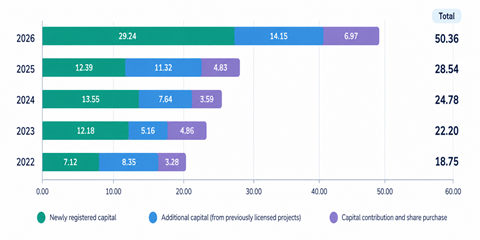
VIETNAM’S REGISTERED FDI SURPASSES $50 BILLION IN NINE MONTHS
According to the National Statistics Office under the Ministry of Finance, total registered foreign direct investment (FDI) reached $50.36 billion as of September 30, up 76.4 per cent on-year. Of the total, newly registered capital came from 3,108 newly licensed projects with combined registered capital of $29.24 billion, up 6.2 per cent in project numbers and 2.4 times the registered capital compared with the same period last year.
Events Sponsors